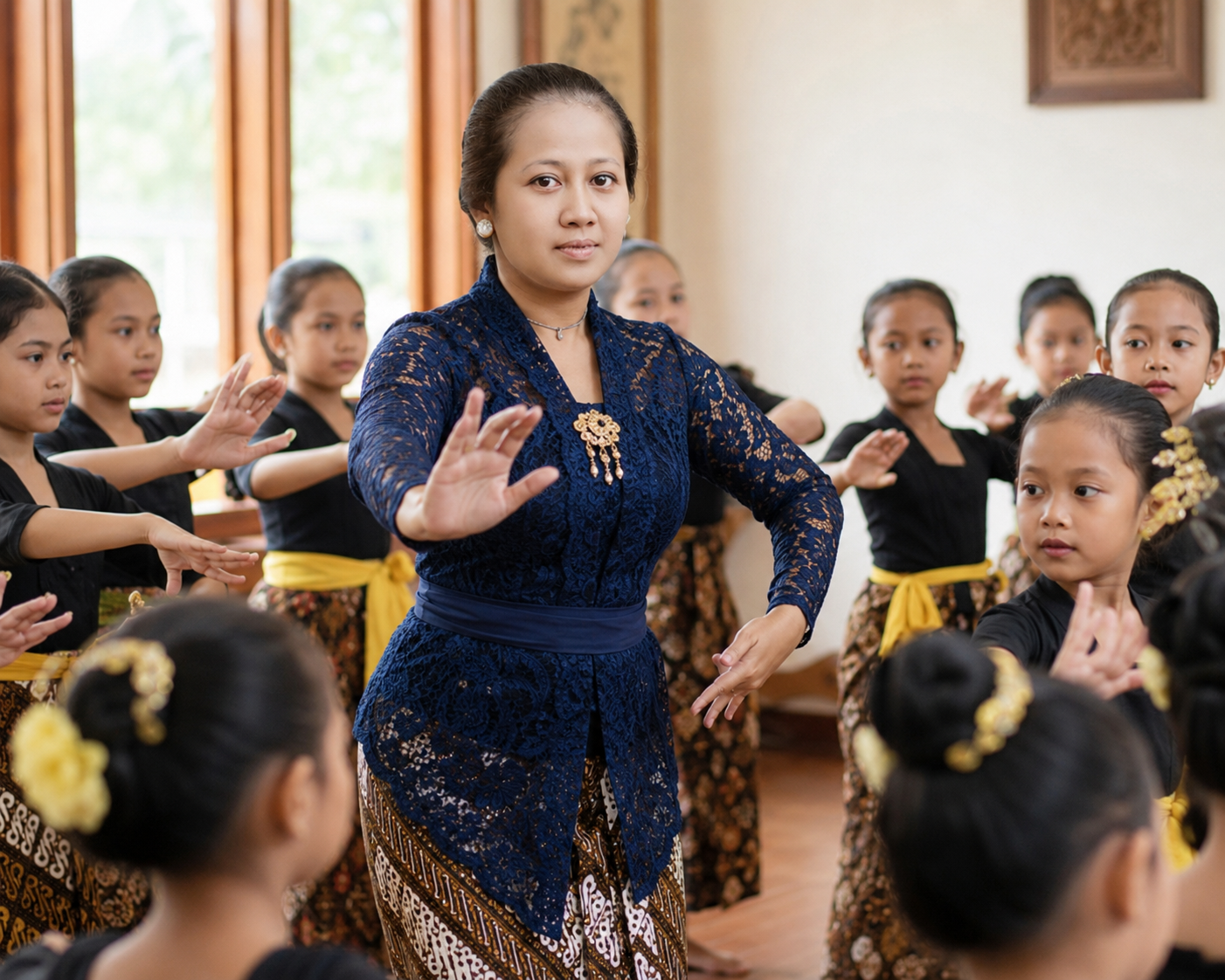
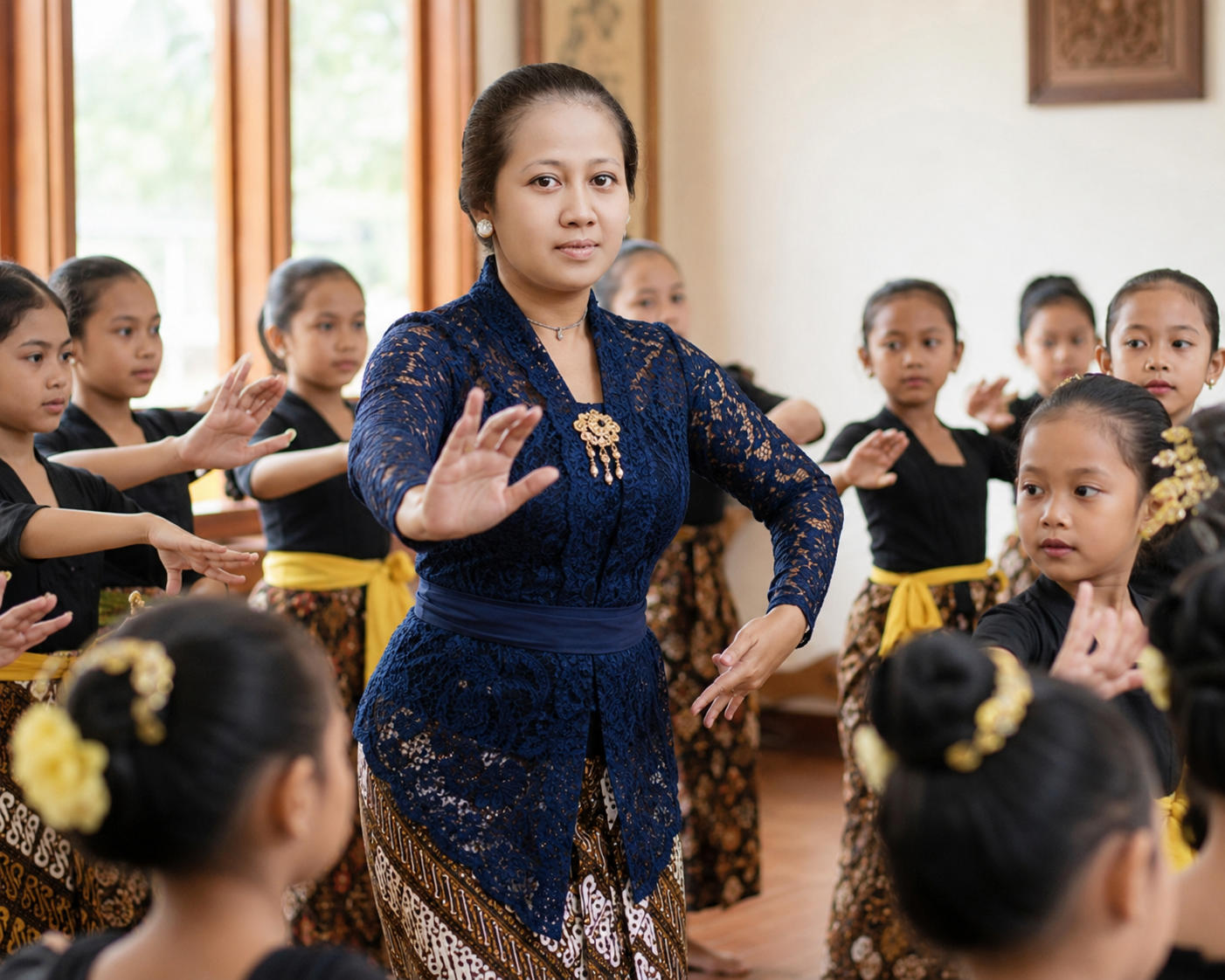
Image Source:Artificial Intelligence (illustration of RA Kartini as a Javanese dance teacher)
Hi everyone, Shalom Aleichem!
Good evening GanSist everyone! 
Welcome back to Superwoman Seriesthe 125th, namely a series that discusses how women can be strong from various sides, from physical, mental, social, to spiritual.
When people hear the term people pleasing, many people immediately imagine someone who is too kind, too friendly, or gives in too often. In fact, behavior like this is often praised as a sign of care and affection.
However, modern psychology shows that people pleasing is not healthy empathy. In many cases, this behavior actually becomes a form of violence. Ironically, the impact is not only felt by the person who does it, but also by the person who continues to receive the help.
Helping is indeed a good deed. However, helping without limits, always solving other people’s problems, or making someone continue to depend on us is not a healthy form of affection. Kindness that is not accompanied by wisdom can actually turn into violence.
Quote:
What Is People Pleasing?
In psychology, people pleasing is the tendency to always try to please other people, even if it means sacrificing one’s own needs, time, energy, values or health.
People who have this tendency usually have difficulty saying “no”, are afraid of disappointing other people, feel guilty if they don’t help, and are busy pursuing other people’s acceptance.
At first glance, this behavior seems noble. However, if done continuously, the relationship that is formed often loses balance. One party keeps on giving. The other party continues to accept. This kind of relationship does not encourage both parties to grow.
Quote:
Violence Doesn’t Always Take the Form of Hitting
So far, people often think that violence only takes the form of threats, teasing, bullying, kicking, hitting, ostracizing or neglect. In fact, various health institutions and international organizations explain that behavior that causes harm can occur in various forms, such as psychological, verbal, sexual, economic violence, or other forms of treatment that damage a person’s well-being. In other words, a behavior does not need to leave physical wounds to have serious consequences.
In the context of people pleasing, the term violence describes that this behavior can maintain unhealthy relationships, strengthen dependency, and cause pressure on other people if carried out continuously.
Quote:
Why Is People Pleasing Violence?
Many people think that the more often they help, the better the results. Unfortunately, reality is not always like that.
Imagine someone who always completes all of his friend’s assignments. Over the years his friend never learned to do it himself.
At first, the help felt good. However, when one day the help stops, the person experiences great difficulties because he never developed his own abilities.
The real problem is not when help is given. Problems arise if this assistance eliminates a person’s opportunity to learn independently.
Educational psychology recognizes the concept that humans develop through a process of learning, trying, failing, and then improving themselves. If every difficulty is always taken over by someone else, the development process will be hampered.
Quote:
Empathy Doesn’t Mean Pampering
Empathy is often misunderstood as an obligation to always fulfill all other people’s wishes. In fact, empathy means understanding another person’s situation while providing assistance according to their needs.
Sometimes, the best help is not providing convenience. The best help is to teach how to find ease.
Sometimes, the best help is not giving exam cheats. The best help is to motivate someone to study hard so they can succeed in the exam.
Sometimes, the best help doesn’t always solve the problem. The best help is to accompany someone so they can solve their own problems.
This is the difference between pampering and empowering. Pampering creates dependency. Empowering creates independence.
Quote:
Addiction Can Be a Source of Stress
Humans are not always in the same situation. Today, a person may always have family, friends, a partner, or coworkers ready to help.
However, circumstances may change. Job changes. Change of residence. Parents died. Fewer friends. Couples have their own busy lives.
When someone never learns to be independent from the start because they always depend on the help of others, changes like this can cause very heavy psychological pressure. He feels unable to make decisions, lacks self-confidence, gives up easily, and finds it difficult to face new challenges.
Under certain conditions, prolonged dependence can also reduce self-confidence because a person feels he is unable to do something without help.
Therefore, a healthy relationship is not one that makes someone more dependent. A healthy relationship makes both parties increasingly able to stand on their own abilities.
Quote:
Why Do People Become People Pleasers?
Research shows that people pleasing tendencies can be influenced by many factors. Some people grow up in an environment where they feel they will only be liked if they always obey. Others are afraid of rejection. There are also those who have low self-esteem so they are constantly tired of pursuing the acceptance of others through self-sacrifice.
As a result, they keep saying “yes” even though they really want to say “no”. They help not because they are always able, but because they are afraid of losing the relationship.
Relationships like this are often filled with stress. It is not love that is the main basis, but fear.
Quote:
Superwoman Helps People Become Independent
Being a strong woman doesn’t mean you have to always solve all other people’s problems. In fact, strong women understand when to help and when to give other people the opportunity to be independent.
If a child was continuously given medicine from a young age so that he never got sick, that child may be healthy today. However, the child also never learned to exercise and dance so that his immune system was strong (as in the illustration in this thread).
Likewise in life. Allowing someone to face challenges that person is still capable of facing is not violence. Often, that’s the learning process necessary for people to become more resilient.
Of course, this principle does not apply to emergencies, disasters, disabilities, serious illnesses, or conditions when a person is truly unable to help himself. In such situations, immediate assistance is still necessary.
What is discussed in this thread is the habit of spoiling people who are actually able to grow when given the opportunity.
Quote:
CLOSURE
Kindness is one of the most beautiful qualities in humans. However, goodness also requires wisdom. Helping others does not mean taking over all their life responsibilities. Healthy empathy does not make someone continue to depend, but rather provides support so that people are able to develop, learn, and stand on their own abilities.
People pleasing often starts with good intentions. However, if carried out without restrictions, this behavior can harm oneself as well as become a form of violence for others. Healthy relationships are not built on dependence, but on the basis of mutual respect, mutual support, and encouraging each other to become more independent individuals.
Superwoman understands that true compassion does not create dependency. True compassion is helping others until one day they are able to move forward on their own with confidence.
Quote:
SOURCE
American Psychological Association. (2023). Healthy relationships and mental health. https://www.apa.org
Beattie, M. (2009). Codependent no more: How to stop controlling others and start caring for yourself(Updated ed.). Hazelden Publishing.
Deci, E. L., & Ryan, R. M. (2017). Self-determination theory: Basic psychological needs in motivation, development, and wellness. Guilford Press.
Feeney, B. C., & Collins, N. L. (2015). A new look at social support: A theoretical perspective on thriving through relationships. Personality and Social Psychology Review, 19(2)113-147.
National Institute for Health and Care Excellence. (2022). Self-esteem: Evidence and guidance. https://www.nice.org.uk
World Health Organization. (2002). World report on violence and health. Geneva: World Health Organization.
World Health Organization. (2022). Mental health and well-being. https://www.who.int
Young, J. E., Klosko, J. S., & Weishaar, M. E. (2003). Schema therapy: A practitioner’s guide. Guilford Press.