Hi everyone, Shalom Aleichem!
Good afternoon GanSist everyone! 
Indonesia is known as one of the countries with the greatest biodiversity in the world. Thousands of types of plants grow naturally in forests, yards, roadsides, and areas that are rarely paid attention to. Interestingly, quite a few of them actually have nutritional value and health benefits, but are still little known to the wider public. One example is Phyllanthus reticulatusa plant which in various regions in Indonesia is known by the name mangsian.
The name “mangsian” apparently has quite an interesting history. The term is thought to originate from the ancient Indian language, namely the word masi, which means ink. This naming is not without reason. Fruit Phyllanthus reticulatus will release a dark purple liquid that tends to be reddish when squeezed or broken. This color really resembles ink, so the fruit has long been used as a natural dye in several regions of Asia.
Even though it is not as popular as commercial fruits such as mango, guava or rambutan, mangsian fruit can actually be eaten when it is ripe. Apart from having a distinctive taste, scientific research shows that various parts of this plant contain bioactive compounds that have the potential to provide health benefits.
Quote:
Getting to know Phyllanthus reticulatus
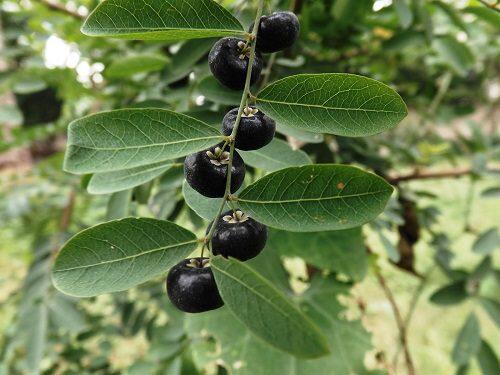
This plant is generally a shrub or woody bush with a height of between 2 and 6 meters. The branches are quite dense so they are often used as living fences. The leaves are oval in shape with a smooth, shiny green surface.
The flowers are small and not very showy. After being pollinated, the flower will develop into a small round fruit with a diameter of about a few millimeters. Young fruit is green, then turns dark red to black when ripe.
The greatest uniqueness of this plant lies in its fruit. When the skin of the fruit is broken, a very dark purple liquid will come out. This natural pigment easily sticks to skin and fabric, so it has long been used as a natural dye.
Quote:
Distribution in Indonesia
This plant grows both in the lowlands and hills with quite diverse soil conditions. In fact, mangsian is often found growing wild on roadsides, bushes, gardens and forest edges.
Its ability to adapt to various environmental conditions makes this plant relatively easy to cultivate without requiring complicated care.
Quote:
Fruit that is Safe to Eat
The taste tends to be sweet with a slight astringent sensation due to tannins, depending on the level of ripeness. Its size is small so it is rarely used as a main fruit for consumption, but it is quite interesting as an edible wild fruit.
However, consumption should remain in reasonable amounts. Research regarding the safety of long-term consumption in large quantities is still relatively limited so the precautionary principle still needs to be applied.
Quote:
Bioactive Compound Content
Various studies have found that it contains flavonoids, phenolic compounds, tannins, terpenoids, saponins, alkaloids, glycosides and various natural antioxidants. These compounds are known to have quite diverse biological activities. Its presence makes this plant interesting to continue research as a source of natural compounds that have the potential to be developed in the food and health sectors.
Quote:
Potential as an antioxidant
Extract Phyllanthus reticulatusdemonstrated the ability to capture free radicals in various laboratory tests. This activity is thought to come from the high content of flavonoids and phenolic compounds.
It should be understood that the results of laboratory research are not necessarily the same as the effects on humans. Therefore, clinical research is still needed to confirm its benefits.
Quote:
Potentially Helps Control Inflammation
A number of experimental studies have found that leaf extracts and other parts of Phyllanthus reticulatushas anti-inflammatory activity. The researchers suspect that this activity is related to the ability of the active compound to inhibit the formation of certain inflammatory mediators.
These findings still require further research in humans, but provide an illustration that this plant has quite promising pharmacological potential.
Quote:
Antimicrobial Activity
However, these results do not mean that this plant can replace clinically proven antibiotics or antifungal drugs. Further research is still needed before it can be applied in the medical world.
Quote:
Used in Traditional Medicine
However, traditional use is not always synonymous with scientific effectiveness. Modern medical science requires proof through rigorous clinical trials so that its benefits and safety can be confirmed.
Quote:
Why is the color of the fruit so deep purple?
Because of these properties, people in several regions of Asia have used it as a natural ink for hundreds of years. In fact, the origin of the name “mangsian” which is related to the word “masi” is proof that this characteristic has been known for a long time.
Currently, natural dyes from various plants are attracting attention again because they are considered more environmentally friendly and better for health than synthetic dyes.
Quote:
Future Development Potential
The increasing interest in functional foods has resulted in many local plants being researched again. Phyllanthus reticulatushas a number of advantages, including:
1) Easy to grow in tropical areas.
2) The fruit can be eaten when ripe.
3) Contains various bioactive compounds.
4) Has the potential to be a source of natural antioxidants.
5) Has a unique natural purple pigment.
6) Has long been used in traditional medicine.
However, all these developments must still be based on strong scientific research so that their benefits and safety are truly guaranteed.
Quote:
CLOSURE
Behind its simple appearance, various studies show that this plant contains flavonoids, phenolics, tannins and various other bioactive compounds which have the potential to act as antioxidants, anti-inflammatory and antimicrobial. However, most of the scientific evidence still comes from laboratory research and animal experiments. Therefore, more clinical trials in humans are needed before its health benefits can be fully confirmed.
Plants such as mangsian remind us that Indonesia’s biological riches still have a lot of potential that has not been fully exploited. With ongoing research, it is not impossible that plants that have been considered just wild bushes will actually become a source of functional food and natural ingredients of high value in the future.
Quote:
SOURCE
Ahuja, M., & Ahuja, A. (2019). Phyllanthus reticulatus: A review on its ethnobotany, phytochemistry, and pharmacological profile. Journal of Pharmacognosy and Phytochemistry, 8(3)2788-2794.
Kew Science. (2026). Plants of the World Online: Phyllanthus reticulatus Poir. Royal Botanic Gardens, Kew.
Nadkarni, KM (2007). Indian Materia Medica(Vol. 2). Popular Publications.
Orwa , C. , Mutua , A. , Kindt , R. , Jamnadass , R. , & Simons , A. (2009). Agroforestree Database: A Tree Reference and Selection Guide Version 4.0. World Agroforestry Centre (ICRAF).
Rashid, M. A., Haque, M. R., & Islam, M. T. (2018). Phytochemical constituents and biological activities of Phyllanthus reticulatus: A review. Journal of Applied Pharmaceutical Science, 8(9)151-158.
World Agroforestry Centre. (2009). Phyllanthus reticulatus. Agroforestree Database.