Hi everyone, Shalom Aleichem!
Good afternoon GanSist everyone! 
Welcome back to the Nusantara Series, a series that discusses the richness of Indonesia from various sides, starting from culture, history, traditions, to uniqueness that often goes unnoticed. After in the previous series we discussed various Indonesian heritages, this time we will visit the western tip of Java Island, specifically Banten Province.
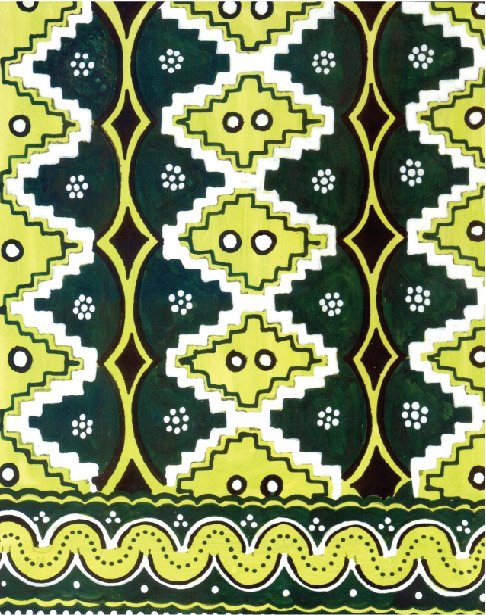
When they hear the word “batik”, most people immediately think of Yogyakarta, Solo or Pekalongan. In fact, Indonesia has many regional batiks that have their own identity. One of which is Banten Batika batik that is relatively young as a regional identity, but actually has very old historical roots.
What makes Banten Batik interesting is not only its beautiful motifs, but also the historical, archaeological and philosophical stories hidden behind each pattern. In fact, some of the motifs were born from the results of scientific research into the heritage of the Banten Sultanate. Things like this are rarely found in batik from other regions.
Here are 4 surprising facts about Banten Batik that are worth knowing.
Quote:
1. Banten Batik Motifs Come from Historical Artifacts of the Banten Sultanate
Many people think that batik motifs are always born from the imagination of craftsmen. This assumption is not entirely true for Banten Batik. The Banten Batik motifs actually come from the results of archaeological research into the remains of the Banten Sultanate, which was once one of the largest Islamic kingdoms in the archipelago in the 16th to 17th centuries. Archaeological research carried out since the 1970s found various decorations on objects such as pottery, ceramics, building ornaments and other artifacts. These decorative variations were then studied and developed into modern batik motifs.
Because they come from historical artifacts, each motif does not just function as decoration. This motif is a medium for reintroducing the glory of the Sultanate of Banten to today’s society.
In other words, wearing Banten Batik is like carrying a piece of historical story written on cloth.
Quote:
2. The names of the motifs are taken from historical figures and terms
Another unique thing about Banten Batik is the naming of its motifs. If batik from other regions often uses the names of plants, animals or natural panoramas, Banten Batik actually uses names that come from historical terms from the Sultanate of Banten.
Some well-known motif names include Surosowan, Kaibon, Pasepen, Datulaya, Singayaksa, Srimanganti, Mandalikan, and even Ratu Mumbay. These names are taken from buildings, titles, palace rooms, and cultural elements that developed during the Banten Sultanate era. This makes Banten Batik different from most Indonesian batik. The name of the motif is not just a label, but also an entry point to learning about regional history.
It is not surprising that Banten Batik is often used as a medium for cultural education, especially for the younger generation who want to know the history of their region in a more interesting way.
Quote:
3. Has around 75 motifs reconstructed from archaeological finds
This is the most amazing fact. The results of the research show that Banten Batik has around 75 motifs which were developed based on various decorative artifacts left by the Sultanate of Banten. This number is the result of the identification and reconstruction process of various archaeological finds, not the result of random creation. This means that each motif has a direct connection to real historical evidence.
This approach is very rarely found in batik from other regions. In many regions, motifs develop through hereditary traditions or the creativity of craftsmen. Meanwhile, Banten Batik developed through collaboration between archaeologists, historians, humanists and batik craftsmen. This is what makes Banten Batik often referred to as the batik that tells everything. Each motif contains traces of a civilization that was victorious hundreds of years ago.
The existence of dozens of motifs also shows that Banten in the past had a rich and complex artistic tradition. This cultural heritage is now coming back to life through the medium of batik cloth.
Quote:
4. Banten Batik Colors Have Different Characters
If we pay attention to Banten Batik, we will find the color nuances tend to be soft. Banten Batik uses a lot of pastel colors such as light grey, cream, light brown, light green and soft blue. This color character is different from coastal batik which usually has bright and contrasting colors.
The choice of color is not without reason. The developers of Banten Batik try to present nuances that reflect the character of the artifacts and historical heritage of the Banten Sultanate, resulting in a graceful, elegant and calm impression.
Because of its simple but classy appearance, Banten Batik is also easy to combine with various modern fashion styles without losing its traditional identity.
Quote:
CLOSURE
Indonesia never runs out of surprises. Banten Batik is proof that cultural heritage is not only passed down through oral stories, but can also be rebuilt through scientific research.
These four facts show that Banten Batik is not just a beautiful patterned cloth. Banten Batik is the result of a combination of history, archeology, art and cultural identity which complement each other. From motifs originating from hundreds of years old artifacts, names that are full of historical meaning, dozens of motifs resulting from scientific reconstruction, to elegant distinctive colors, everything makes Banten Batik have a unique character among Indonesian batiks.
Hopefully more and more Indonesian people will know and love Banten Batik. Because preserving culture is not only the task of the government or cultural figures, but also the responsibility of the entire Indonesian nation.
What do you think GanSist? Of the 4 facts above, which one amazed GanSist the most?
Quote:
SOURCE
Apriyani, KT, Setyobudi, I., & Dwiatmini, S. (2020). Batik motifs as icons and new myths for the identity of Lebak Regency. Journal of Ethnic Culture, 5(1).
Sulasiah. (2022). Banten Batik: Representation of the history of the glory of the Sultanate of Banten in the 17th century. Candrasangkala Journal of History Education, 8(2).
Sulasiah. (2024). Islam and cultural identity in Banten Batik motifs (2004-2024). Faculty of Adab and Humanities, UIN Syarif Hidayatullah Jakarta.
Marwoto, I., Nasution, IP, Sulistyowati, D., & Assilmi, G. (2015). Banten Batik Motif (Queen Mumbai)(Patent No. 072481). University of Indonesia.
@hahahaha @salamsehaat @strangerfdotnet