Hi everyone, Shalom Aleichem!
300x600
300x600
Good afternoon GanSist everyone!
Welcome back to the Nusantara Series, a series that invites us to get to know Indonesia through culture, history, local wisdom, natural wealth, and the knowledge hidden behind everyday life. In the previous series we discussed the uniqueness of the Java Sea which apparently holds ancient rivers from the former Sunda Land. This time, we will discuss something much closer to our lives, namely typical Sundanese food.
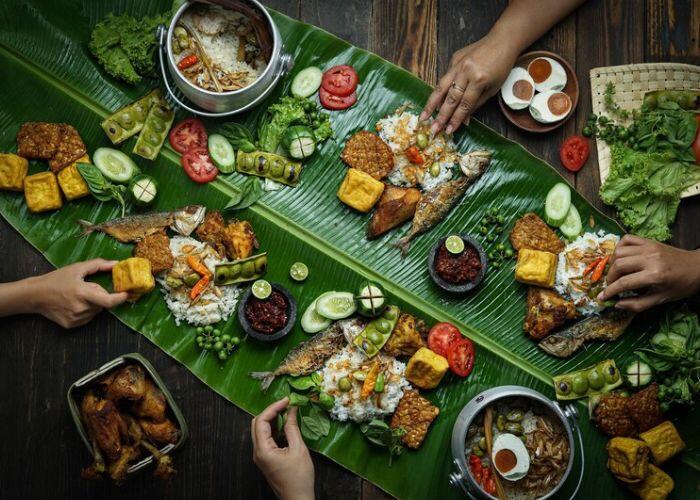
Sundanese culinary is widely known for its fresh, light taste and not using too many strong spices. When compared to several other Indonesian dishes which are rich in coconut milk or have a strong spicy taste, Sundanese food tends to maintain the natural taste of each food ingredient.
Interestingly, the various eating habits of the Sundanese people apparently have a fairly strong scientific basis. This does not mean that all Sundanese food is necessarily healthy or can be eaten without limits, but in general the presentation pattern contains many elements that are in accordance with the principles of balanced nutrition.
So, what are the reasons why Sundanese food is often considered good for health?
Quote:
1. Rich in fresh vegetables that are a source of fiber
One of the most easily recognized characteristics of Sundanese food is the presence of fresh vegetables. In one serving of Sundanese food, there are almost always a variety of fresh vegetables such as cucumber, lettuce, cabbage, basil, poh-pohan leaves, tomatoes, leunca, and long beans. These vegetables are usually eaten raw or only boiled briefly so that the texture remains crunchy.
From a nutritional point of view, this habit provides many benefits. Vegetables are a source of dietary fiber, vitamins, minerals and various phytochemical compounds that act as antioxidants. Fiber helps facilitate digestion, increases feelings of fullness, maintains healthy gut microbiota, and helps control blood sugar and cholesterol levels.
The World Health Organization (WHO) recommends consuming at least 400 grams of fruit and vegetables every day to help reduce the risk of non-communicable diseases such as heart disease, stroke and several types of cancer. The presence of fresh vegetables in Sundanese food supports this recommendation if consumed hygienically and as part of a balanced diet.
Thus, the simple habit of serving fresh vegetables turns out to have high health value.
Quote:
2. Use lots of fish as a source of quality protein
Apart from vegetables, Sundanese food is also very familiar with various processed fish, such as tilapia, goldfish, gourami fish, tilapia fish and sea fish. Protein from fish has high biological quality because it contains essential amino acids that the body needs.
Apart from that, fish is also a source of vitamin D, vitamin B12, selenium, iodine, and certain types of fish contain omega-3 fatty acids.
Omega-3 fatty acids have been widely studied because they are related to heart health, brain function, and the process of controlling inflammation in the body.
Therefore, various international health institutions recommend regular consumption of fish as part of a healthy diet.
In Sundanese cuisine, fish is often prepared by grilling, grilling, steaming, or making pepes. This cooking technique generally requires less oil than large frying methods, so it can help reduce additional fat intake.
Of course, these benefits will be more optimal if fish consumption is accompanied by a variety of other foods.
Quote:
3. The cooking process is relatively simple so the natural taste of the ingredients is maintained
This is the reason that is probably the easiest for many people to feel. If you have ever enjoyed Sundanese food, you will realize that the taste of vegetables still tastes like vegetables, the taste of fish remains dominant as fish, and the aroma of spices is used to strengthen the taste, not cover it up.
Scientifically, cooking methods such as boiling, steaming, grilling, or wrapping in banana leaves (pepes) help maintain the character of food ingredients. Some of these methods can also reduce the need for oil in the cooking process.
Apart from that, using banana leaves as a wrapper for pepes gives it a distinctive aroma without needing to add a lot of fat. Spices such as garlic, shallots, turmeric, ginger, galangal, lemongrass and basil also contain various bioactive compounds which are being widely researched because they have antioxidant and anti-inflammatory activity.
This does not mean that these spices can replace medicine, but their existence shows that traditional Indonesian food is rich in natural ingredients that have nutritional value and potential health benefits.
It is not surprising that many people feel that Sundanese food still tastes light even though it is filling.
Quote:
4. Using lots of diverse local food ingredients
Sundanese people have long utilized agricultural products in their surroundings. Apart from rice, there are also processed cassava, taro, sweet potatoes, corn, as well as various types of local beans and vegetables. This diversity of food ingredients provides a variety of nutrients so that diets do not depend on just one type of food.
From a nutritional science perspective, food diversity is an important principle to meet the needs for vitamins, minerals, protein, healthy fats and carbohydrates in a more balanced manner.
Food diversity also helps maintain local food security. When people use their own regional agricultural products, the distribution chain becomes shorter and the food they consume is generally fresher.
This is one of the reasons why many nutritionists encourage people to consume more local food.
Quote:
5. Encourage the consumption of fresh food
One of the typical characteristics of Sundanese food is the use of fresh ingredients. Vegetables are usually freshly harvested before being marketed. Basil leaves, cucumbers, tomatoes, and various other fresh vegetables are often served without a long processing process. Likewise, many fish are obtained from ponds, rivers, reservoirs and the sea.
Fresh food generally has better taste quality so it doesn’t require too much salt, sugar or flavoring to produce delicious food.
However, there is one thing that still needs to be considered. Because some vegetables are eaten raw, the washing process must be done properly so that they are free from soil, pesticide residues and microorganisms that can cause disease. With hygienic processing, the benefits of consuming fresh vegetables will be much more optimal.
This means that health is not only determined by the type of food, but also by how it is processed.
Quote:
CLOSURE
Sundanese culinary is an example of how local culinary traditions can be in harmony with the principles of modern nutritional science. The habit of serving fresh vegetables, eating fish, using simple cooking methods, using a variety of local foods, and prioritizing fresh ingredients provides various health benefits if implemented in a balanced diet.
However, it is important to understand that no one type of food can meet all of the body’s nutritional needs. Sundanese food still needs to be consumed in appropriate portions, accompanied by physical activity, adequate sleep and other healthy lifestyle patterns. Apart from that, some Sundanese dishes can also contain high amounts of salt or chili sauce so consumption still needs to be adjusted to individual health conditions.
Through the Nusantara Series, we learn again that the richness of Indonesian culture is not only visible in traditional clothing, dances or historical buildings, but also in its culinary traditions. Behind a plate of rice, fresh vegetables, chili sauce, pepes and grilled fish, it turns out there are many lessons about nutrition, balance and the relationship between humans and nature.
The more we get to know traditional Indonesian food scientifically, the more we realize that much of the archipelago’s culinary heritage is not only delicious, but also contains health values that are worth preserving.
Quote:
SOURCE
Food and Agriculture Organization of the United Nations. (2019). Sustainable healthy diets: Guiding principles. FAO.
Ministry of Health of the Republic of Indonesia. (2022). Guidelines for Balanced Nutrition. Directorate General of Public Health.
World Health Organization. (2020). Healthy diet. World Health Organization. https://www.who.int/news-room/fact-s…l/healthy-diet
Gibney, M. J., Lanham-New, S. A., Cassidy, A., & Vorster, H. H. (Eds.). (2020). Introduction to Human Nutrition(3rd ed.). Wiley-Blackwell.
Harvard T.H. Chan School of Public Health. (2024). The Nutrition Source: Vegetables and Fruits; Fish. Harvard University.
@strangerfdotnet @salamsehaat @jokingwet