Hi everyone, Shalom Aleichem!
Good afternoon GanSist everyone!
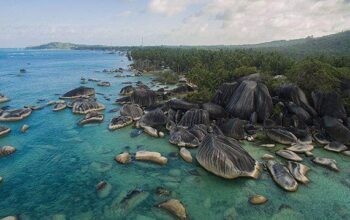
Welcome back to the Nusantara Series, a series that invites us to explore Indonesia’s riches from various sides, starting from culture, history, local wisdom, culinary delights, tourist attractions, to the natural riches of the archipelago. In the previous series we got to know the Natuna Islands, a group of islands in northern Indonesia that attracts the beauty of the sea, granite rocks and rich biodiversity. This time, our trip returns to the Riau Islands Province to visit a small island that has had a huge influence on the nation’s history, namely Penyengat Island.
At first glance, Penyengat Island looks like a small, quiet island opposite Tanjung Pinang City. The area is only about two square kilometers and can be reached by motorboat in about 15 minutes from Sri Bintan Pura Harbor. However, don’t be fooled by the size. On this island, various great ideas were born regarding literature, the Malay language, the government of the Riau-Lingga Sultanate, and the development of cultural identity which would later influence the birth of modern Indonesian.
Penyengat Island is not only interesting for tourists, but is also a valuable historical laboratory. Almost every corner of the island contains stories about characters, kingdoms and literary works that are still remembered today.
So, what are some unique facts about Penyengat Island?
Quote:
1. Once the center of the Riau-Lingga Sultanate
The first fact is related to its great role in Malay history.
In the 18th to early 20th centuries, Penyengat Island developed into one of the centers of government of the Riau-Lingga Sultanate. It was from this island that various royal policies were carried out, diplomatic relations were established, and religious and educational activities developed rapidly.
Even though its area is relatively small, Penyengat Island has a very strategic position because it is on the Malacca Strait trade route. This location makes this area busy with traders from various regions of Southeast Asia.
Until now, various historical remains such as palace complexes, sultans’ tombs, defensive forts, and government buildings can still be found. The existence of these sites makes Penyengat Island one of the most important cultural heritage areas in the Riau Islands.
Quote:
2. Has the Sultan of Riau Mosque which was built using egg whites
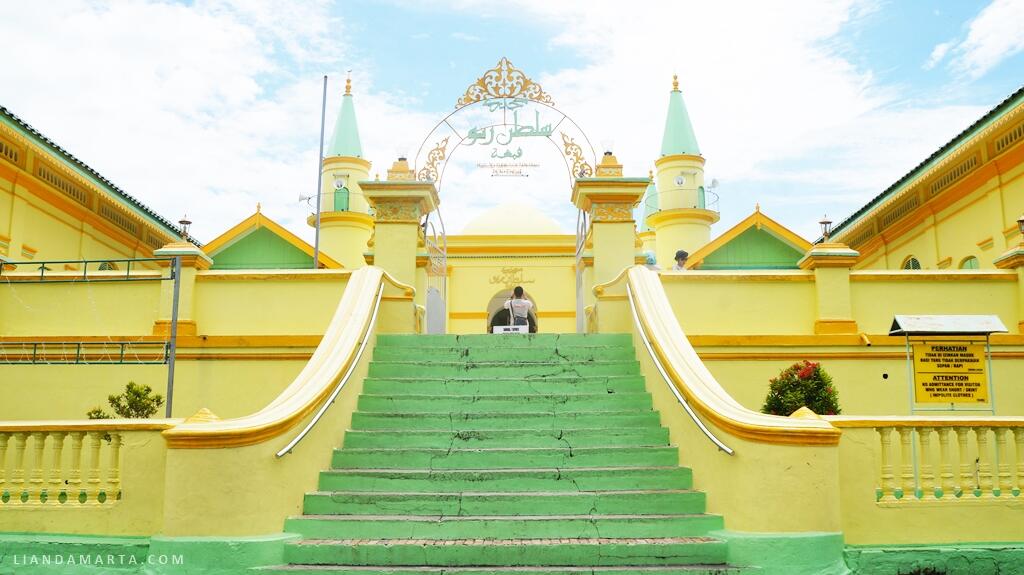
One of the icons of Pulau Penyengat is the Sultan Riau Mosque which stands majestically with the typical Malay yellow color.
This mosque, which was built around 1832 during the time of Sultan Abdurrahman Muazzam Syah II, has a very unique story. According to various historical records and oral traditions of the local community, a mixture of egg whites was used as an adhesive along with lime and other materials in the process of building mosques.
In the past, the use of organic materials such as egg whites was known in several traditional construction techniques in various parts of the world to increase the adhesion of mortar. Although the exact composition is difficult to verify scientifically at this time, the story has become part of the historical identity of the Riau Sultan Mosque.
Apart from its unique construction, this mosque has also been the center of religious activities and Islamic education in the Malay region for many years.
Quote:
3. Being the place of work of Raja Ali Haji, a great figure of the Malay language
This is the fact that best fits the title of the thread.
Penyengat Island is the residence as well as the work place of Raja Ali Haji, one of the most influential figures in the history of the Malay language. He is known as a writer Gurindam Twelveliterary works that are still studied today because they contain moral, ethical and educational values.
Not only that, Raja Ali Haji also arranged Book of Language Knowledgewhich is considered to be one of the most important Malay dictionaries and grammars of its time. His thinking contributed greatly to the standardization of the Malay language which later developed into the modern Indonesian language.
Walking on Penyengat Island seems to take us back to a time when science, literature and the Malay language developed rapidly. The realization that a small island is capable of giving birth to a figure with such great influence really makes anyone’s soul “stung” by his intelligence.
Quote:
4. Almost the entire island is a cultural heritage area
The next unique thing is the density of historical sites this island has.
In an area that is not too large, tourists can find the tombs of sultans and nobles, palace complexes, traditional halls, defensive forts, old wells, and various traditional Malay houses. Many of these buildings have been designated as part of protected cultural heritage areas.
The existence of these sites provides an overview of the life of the Malay people during the Riau-Lingga Sultanate era. For researchers of history, archeology and traditional architecture, Penyengat Island is a very important location for understanding the development of Malay civilization in the archipelago.
Apart from being a tourist attraction, this area also functions as an educational space for the younger generation to learn more about the history of their nation.
Quote:
5. Becomes an important symbol of Malay cultural identity in Indonesia
The final fact relates to the meaning of Penyengat Island for Indonesia.
Penyengat Island is not only the pride of the people of the Riau Islands, but also has an important meaning for the development of national culture. The Malay literary traditions, language, education and values that developed on this island have contributed to the formation of Indonesia’s identity as a pluralistic nation.
Every year, various cultural activities, seminars and festivals are held to reintroduce the intelligent heritage of Penyengat Island to the wider community. These preservation efforts are proof that history is not just a story of the past, but a source of inspiration for future development.
By continuing to protect Penyengat Island, we are also protecting one of the important roots of the development of Indonesian language and culture.
Quote:
CLOSURE
Penyengat Island proves that the size of an area does not determine the amount of influence it can have on history. From this small island, the Riau-Lingga Sultanate government developed, the iconic Riau Sultan Mosque was established, the monumental works of Raja Ali Haji were born, various cultural heritage sites were preserved, and Malay cultural values grew which are still alive today.
Through the Nusantara Series, we learn again that Indonesia has many places that are not only visually beautiful, but also rich in historical and scientific value. Penyengat Island teaches that language, literature and culture are heritage that is as valuable as natural wealth.
Hopefully more and more Indonesians will visit Penyengat Island with a passion for learning and appreciating history. Preserving cultural sites like this means maintaining the bridge that connects today’s generation with the long journey of the Indonesian nation towards its identity as a country rich in culture and civilization.
Quote:
SOURCE
Andaya, B. W. (1975). The Kingdom of Johor 1641–1728: Economic and Political Developments. Oxford University Press.
Ministry of Education, Culture, Research and Technology of the Republic of Indonesia. (2023). Penyengat Island National Cultural Reserve. Directorate General of Culture.
National Library of the Republic of Indonesia. (2019). Raja Ali Haji and Malay Intellectual Heritage. Jakarta: National Library of the Republic of Indonesia.
UNESCO. (2020). Memory of the World: The Legacy of Raja Ali Haji. Paris: UNESCO.
Yusuf, M. (2018). History of the Riau-Lingga Sultanate. Tanjung Pinang: Marwah Indo Media.
@itkgid@strangerfdotnet @jokingwet