Hi everyone, Shalom Aleichem!
Good evening GanSist everyone! 
Welcome back to the Nusantara Series, a series that invites us to get to know Indonesia through culture, history, local wisdom, culinary delights and natural wonders spread from Sabang to Merauke. In the previous series we discussed the scientific reasons why Sundanese food is known as one of the traditional diets that is good for health. This time, we will cross to the largest island in Indonesia, namely Kalimantan, to get to know one of its increasingly developing cultural riches, namely typical Kalimantan batik.
So far, many people consider batik to be synonymous with Java. In fact, after Indonesian batik was designated as an Intangible Cultural Heritage by UNESCO in 2009, various regions in Indonesia became increasingly active in developing batik that reflected their local identity. Kalimantan is one of the regions that has succeeded in presenting batik with a character that is very different from batik in other regions.
Kalimantan Batik is not only beautiful to look at, but is also a medium for introducing the culture of the Dayak people, the richness of tropical rain forests, large rivers, and various flora and fauna endemic to the island of Kalimantan. The pattern is rich in meaning and shows the close relationship between humans and nature.
So, what makes Kalimantan Batik so special?
Quote:
1. Many of the motifs are inspired by Dayak culture
The first uniqueness of Kalimantan Batik lies in its source of inspiration.
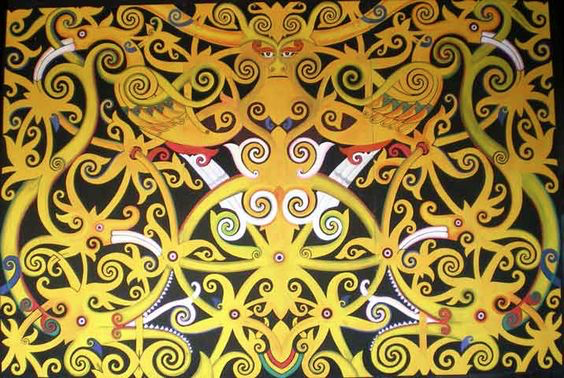
Most of the typical Kalimantan batik motifs take elements from Dayak culture which has developed over centuries. Traditional Dayak decorations, carvings on betang houses, war shields, mandau, and traditional ceremonial ornaments are the main inspiration for batik craftsmen.
These motifs generally have symmetrical patterns, distinctive curves and connected lines. In Dayak culture, various ornaments not only function as decoration, but also have philosophical meanings related to life, harmony, courage, protection, and the relationship between humans and nature.
Therefore, wearing Kalimantan Batik is not only wearing beautiful patterned cloth, but also carrying stories about one of the oldest cultures in the archipelago.
Quote:
2. Raising the Wealth of Kalimantan’s Endemic Flora and Fauna
If you look closely, many Kalimantan Batik motifs feature typical plants and animals that are not found in many other areas.
Some motifs raise black orchids (Coelogyne pandurata), Nepenthes (Nepenthes), fern leaves, to the ironwood tree known as ironwood. From the animal group, there are motifs of hornbills (hornbills), proboscis monkeys, Kalimantan orangutans, red arowana fish, and endemic butterflies.
The selection of flora and fauna is not just to beautify the motif. Its presence is also a reminder that Kalimantan is one of the world’s centers of biodiversity. By incorporating natural elements into batik, the craftsmen are introducing the importance of protecting tropical forests which are the habitat of these various species.
Through a piece of cloth, messages about nature conservation can be conveyed in a subtle but meaningful way.
Quote:
3. Every region in Kalimantan has its own characteristics of Batik
This is the most astonishing fact. Many people think that Kalimantan Batik only has one style. In fact, each province and even several districts in Kalimantan develop different motifs according to their respective regional identities.
In South Kalimantan, for example, the Sasirangan Batik motif is known which combines batik elements with the identity of sasirangan cloth. In East Kalimantan, many motifs take inspiration from Dayak Kenyah culture and the richness of the Mahakam River. Meanwhile, in Central Kalimantan, Dayak Ngaju decorations are the main source of inspiration. West Kalimantan is developing motifs influenced by Dayak, Malay and coastal culture, while North Kalimantan is starting to introduce motifs that highlight Tidung culture and the natural riches of the border region.
These differences show that Kalimantan Batik is not a uniform type of batik. In contrast, Kalimantan Batik is a collection of various cultural identities that grew on the same island.
This diversity reflects Indonesia’s motto, Bhinneka Tunggal Ika, because even though the motifs are different, they are all still part of the richness of Indonesian batik.
Quote:
4. Become a means of preserving culture and the environment
The final uniqueness is the function of Kalimantan Batik which is not only a fashion product.
Currently, many local governments, universities, cultural communities and micro businesses use batik as a medium for education about local culture. Motifs depicting traditional houses, hornbills, orangutans, rainforests and large rivers help introduce the richness of Kalimantan to the wider community.
Apart from that, a number of craftsmen have also begun to use natural dyes derived from local plants as a form of support for more environmentally friendly textile production. Although synthetic dyes are still widely used because they are more practical, the use of natural ingredients is gaining attention again because they are considered more sustainable.
Thus, Kalimantan Batik not only plays a role in maintaining cultural identity, but also becomes a means of increasing awareness about the importance of environmental conservation.
Quote:
CLOSURE
Kalimantan Batik proves that Indonesia’s cultural heritage continues to evolve with the times without losing its identity. Through motifs inspired by Dayak culture, endemic flora and fauna, and the natural riches of Kalimantan Island, each piece of cloth is able to tell a different story.
These four facts show that Kalimantan Batik is more than just traditional clothing. Kalimantan Batik is a medium for cultural expression, a means of education, a symbol of regional identity, as well as a reminder of the importance of protecting tropical forests which are the lungs of the world.
Through the Nusantara Series, we again discover that every region in Indonesia has a unique way of expressing its identity. If Banten Batik highlights the history of the Sultanate of Banten, Minahasa Batik shows the rich culture of North Sulawesi, then Kalimantan Batik presents harmony between humans, culture and nature which has been part of people’s lives for centuries.
The more we know about batik from various regions, the more we understand that Indonesia’s cultural diversity is not something that separates us, but is a strength that makes this nation so rich and special.
Quote:
SOURCE
Aziz, A., & Wahyuni, S. (2021). Development of batik motifs based on local Kalimantan culture as regional identity. Journal of Arts and Culture Education, 6(2)85-96.
Directorate General of Culture, Ministry of Education, Culture, Research and Technology. (2022). Indonesia’s Intangible Cultural Heritage. Jakarta: Ministry of Education and Culture.
UNESCO. (2009). Indonesian Batik: Representative List of the Intangible Cultural Heritage of Humanity. UNESCO. https://ich.unesco.org/en/RL/indones…an-batik-00170
Indonesian Batik Foundation. (2021). Indonesian Batik: Philosophy, Variety of Motifs, and Its Development. Jakarta: Indonesian Batik Foundation.
Region XIV Cultural Preservation Center. (2023). Dayak Traditional Decorations as Kalimantan’s Cultural Identity. Ministry of Culture of the Republic of Indonesia.
@strangerfdotnet@salamsehaat @jokingwet