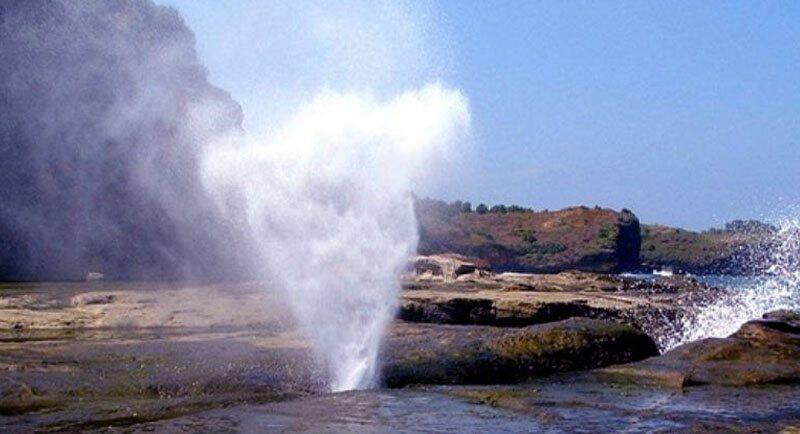
Enjoy the unique natural flutes and natural fountains at Klayar Beach
7 min read
2
×
Enjoy the unique natural flutes and natural fountains at Klayar Beach
Share this article
Hi everyone, Shalom Aleichem!
300x600
300x600
Good evening GanSist everyone!
Indonesia is an archipelagic country that has a coastline of more than 99,000 km. Indonesia’s coastal landscape is very diverse, from white sandy beaches, coral cliffs, mangrove forests, to naturally formed lagoons. This diversity makes Indonesia one of the countries with the largest marine tourism potential in the world. In previous series in the Nusantara Series, various Indonesian treasures have been discussed, starting from traditional culinary delights, winter in Dieng, Merauke Regency, national parks, to ornamental plants that have ecological value. This time, the discussion invites us to go to one of the beaches that has unique geological phenomena on the island of Java, namely Klayar Beach in Pacitan Regency, East Java.
Klayar Beach not only offers stretches of white sand and expansive views of the Indian Ocean. This beach is known for having two natural phenomena that are rarely found in other places, namely natural sea flutes and natural fountains which are often referred to as sea blowor sea water spraying through gaps in coral rocks.
These two phenomena are the main attraction for tourists. Sounds that resemble flutes and water spray that can reach several meters create a different experience compared to other beaches in Indonesia. This phenomenon is not the result of human engineering, but a natural process that has been going on for thousands or even millions of years.
Quote:
Overview of Klayar Beach
Klayar Beach is in Donorojo District, Pacitan Regency, East Java Province. The location is in the southern coastal area of Java Island which directly faces the Indian Ocean.
The southern coastal region of Java is known to have relatively large waves because it is directly facing the open ocean. Waves that continuously hit the coastal rocks for a very long time form various unique geological structures, including coral cliffs, rock crevices, sea caves, and natural holes which are the origin of the flute and fountain phenomena on Klayar Beach.
Apart from its geological phenomena, this beach also has white-brown sand, artistic coral rocks, and beautiful sunset panoramas, making it one of the leading tourist destinations in Pacitan.
Quote:
Amazing Natural Flute Phenomenon
One of the unique characteristics of Klayar Beach is the sound that resembles the sound of a flute. Because of its uniqueness, people often call it a sea flute.
Scientifically, this sound occurs when sea waves enter narrow gaps or cavities in coral rocks. The air trapped in the cavity is then pushed out due to the pressure of the sea waves. When air passes through a hole of a certain size, a sound is formed that sounds like a flute blowing.
This principle is actually similar to how some wind instruments work. The difference is, on Klayar Beach there are no people blowing musical instruments. Nature uses a combination of waves, air pressure, rock shape and gap size to produce these sounds.
The sound produced is not always the same every time. Wave intensity, wind direction, tides and weather conditions affect the strength of the sound heard. When the waves are big enough, the sound of the flute can usually be heard more clearly than when the sea is relatively calm.
This phenomenon shows how simple physical processes can produce very interesting tourist experiences.
Quote:
Natural Fountain or Sea Blow
Apart from the sound of the flute, Klayar Beach is also famous because it has natural sea water spray which is often mentioned sea blow.
This phenomenon occurs when large waves enter channels or cavities under coral rocks. Sea water that is pushed into the cavity experiences increased pressure because the space under the rock is relatively narrow.
When the pressure is large enough, the water will find a way out through the vertical cracks at the top of the rock. As a result, a jet of water is formed which can reach several meters into the air so that it looks like a fountain.
Phenomenon sea blowcan actually be found in several coastal areas of the world, but each location has different characteristics depending on the shape of the rock, the size of the cavity, and the strength of the waves.
At Klayar Beach, the combination of coral rock structures and Indian Ocean waves produces spray which is one of the main attractions for tourists.
However, visitors still need to maintain a safe distance. Indian Ocean waves are known to be strong and can change quickly. Following the safety instructions from the tour manager is a very important step.
Quote:
Evidence of Natural Forces Working for Millions of Years
The coral rocks on Klayar Beach were not formed in a short time. The geological structures visible today are the result of natural processes that have lasted a very long time.
Sea waves continuously hit the rocks, gradually eroding the surface. This process is known as coastal erosion. Over thousands to millions of years, abrasion forms cracks, sea caves, vertical holes, and various unique rock shapes.
The flute phenomenon and sea blowis the final result of this long geological process.
Seeing these two phenomena reminds us that nature is capable of creating “works of art” through a very slow process, far beyond the lifespan of one human generation.
Quote:
Tourism that combines beauty and education
Klayar Beach is not only suitable as a vacation spot, but also as a natural learning location. Teachers, students and students can take advantage of a visit to this beach to study various scientific concepts, such as geology, oceanography, wave physics, coastal erosion, and environmental conservation.
By seeing directly how waves form rocks, students will more easily understand that the theories studied in the classroom actually occur in nature.
This approach is known as contextual learning, namely connecting scientific concepts with real conditions in the field.
Quote:
Maintaining the Beauty of Klayar Beach
The uniqueness of Klayar Beach can only be enjoyed if environmental sustainability is maintained. Plastic waste, vandalism on rocks, and irresponsible tourist activities can reduce the quality of tourist areas.
Therefore, every visitor has the responsibility to keep the beach clean, not climb dangerous rocks, not throw rubbish carelessly, and obey the rules set by the management.
Conservation of tourist areas is not only the government’s task, but also the responsibility of the entire community.
Quote:
Why is Klayar Beach Worth Visiting?
Klayar Beach has a combination that other tourist destinations rarely have.
First, the natural panorama is very beautiful with white sand, coral rocks and open sea.
Second, there is the sea flute phenomenon which is the result of the interaction of air and waves with rock structures.
Third, there is sea blowwhich creates natural water jets as a unique geological attraction.
Fourth, this area has high educational value because it shows directly how the abrasion process and ocean wave dynamics work.
Fifth, the existence of Klayar Beach enriches the list of Indonesian geotourism destinations that are worthy of being known by both domestic and foreign tourists.
Quote:
CLOSURE
Klayar Beach proves that Indonesia is not only rich in beautiful beaches, but also has unique natural phenomena and scientific value. The sound of natural flutes and natural fountains are not miracles that violate the laws of nature, but are the result of the interaction between Indian Ocean waves, air pressure, and the shape of coral rocks that are formed through geological processes over a very long time.
This uniqueness makes Klayar Beach a destination that can combine recreation, education and appreciation of nature. Visiting places like this not only provides a pleasant tourist experience, but also raises awareness that Indonesia’s natural landscape is a heritage that must be protected together.
The more we understand the scientific processes behind the natural beauty of the archipelago, the greater our sense of gratitude and responsibility to preserve it so that it can be enjoyed by future generations.
Quote:
SOURCE
Geospatial Information Agency. (2023). Indonesian Coastal Geospatial Information. Cibinong: BIG.
Ministry of Tourism of the Republic of Indonesia. (2023). The charm of Klayar Beach, Pacitan. Jakarta: Ministry of Tourism.
Sunarto. (2016). Geomorphology of Indonesian Coasts. Yogyakarta: Gadjah Mada University Press.
United Nations Educational, Scientific and Cultural Organization. (2021). UNESCO Global Geoparks: Celebrating Earth Heritage, Sustaining Local Communities. Paris: UNESCO.
United States Geological Survey. (2023). Coastal Processes and Shoreline Change. Reston, VA: U.S. Geological Survey.