———
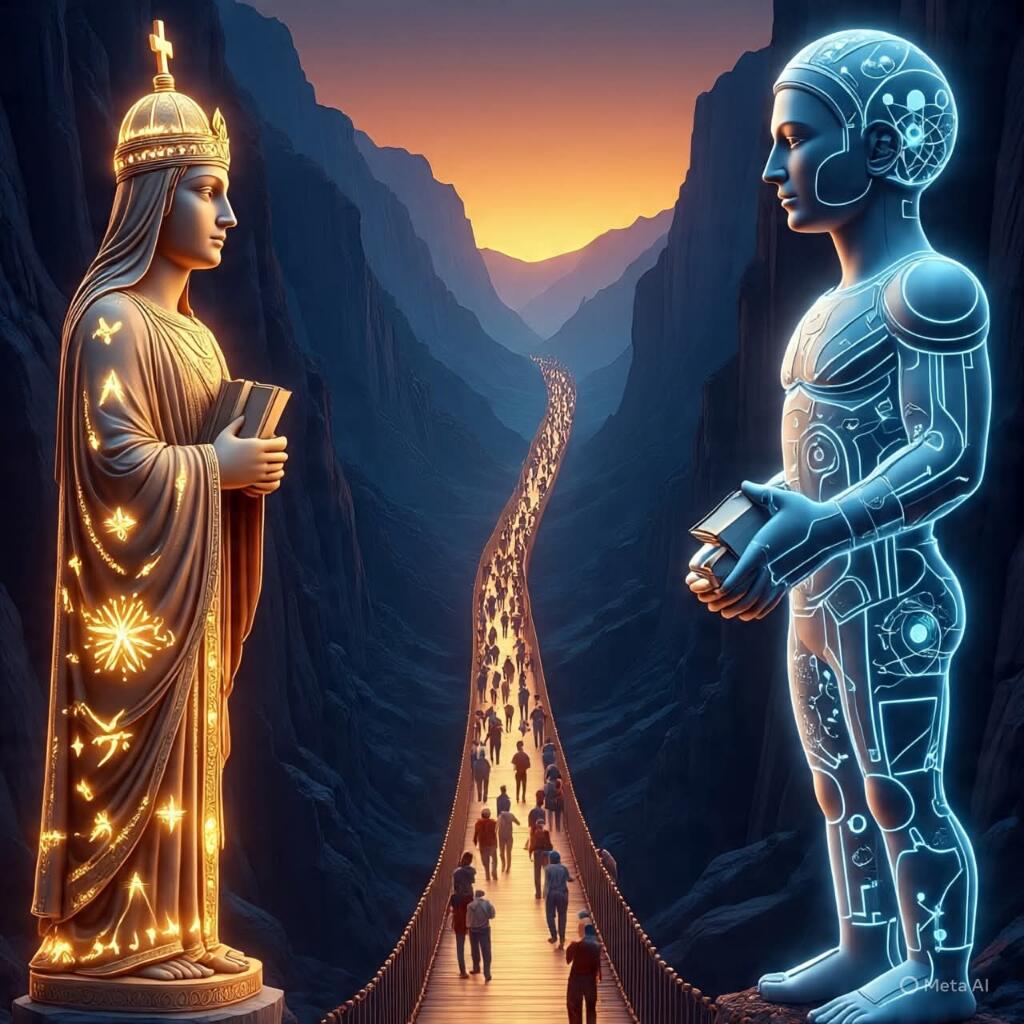
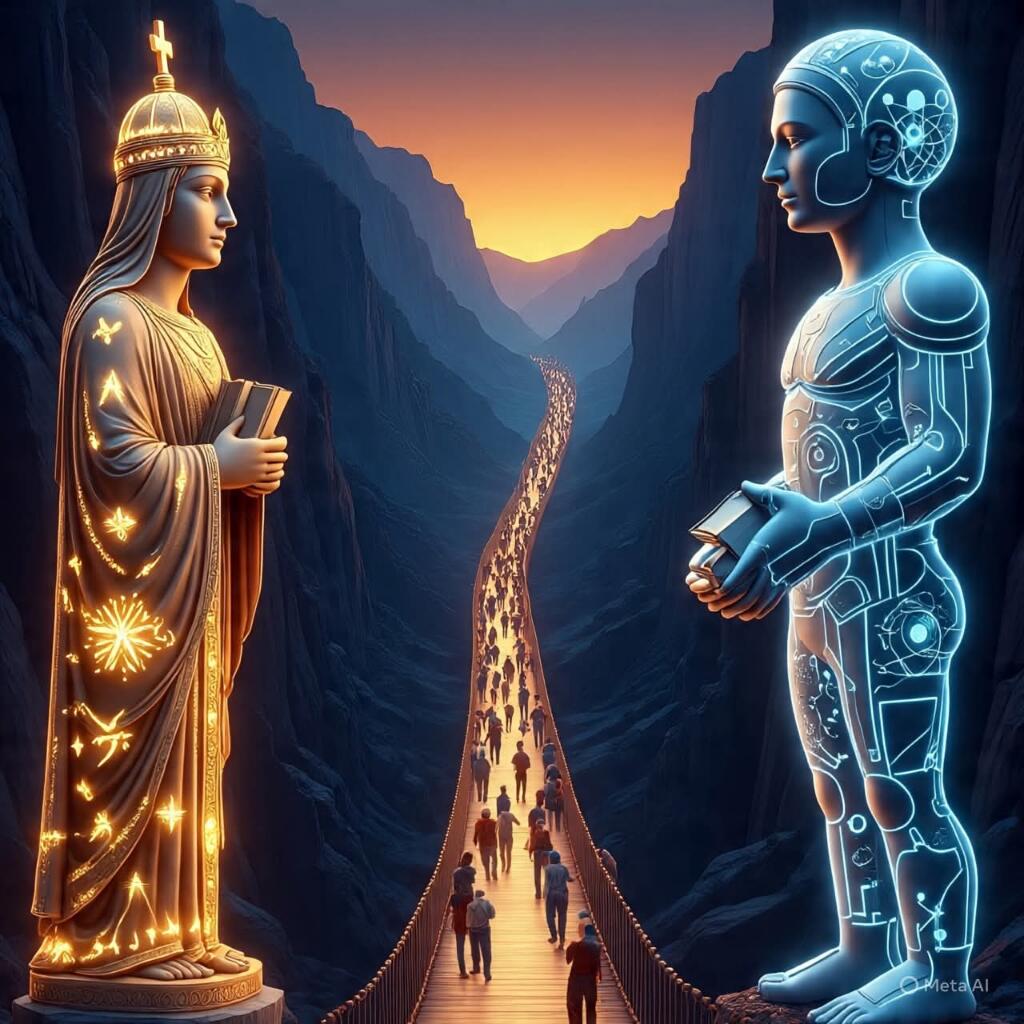
The history of the debate between religion and science is actually much more complicated than the popular narrative that often depicts it as an “eternal war.” In many historical periods, religion and science actually grew side by side, even supporting each other. However, there are also times when the two clash due to different ways of understanding reality.
1. Ancient World: No Clear Separation Yet
In ancient civilizations such as Mesopotamia, Ancient Egypt and Ancient Greece, knowledge about nature was still integrated with religious beliefs.
Greek philosophers such as Aristotle tried to explain nature through observation and logic, but they still spoke about the metaphysical purpose and order of the cosmos. There was no concept of “science” as we know it today.
2. Middle Ages: Religion Becomes the Protector of Knowledge
The narrative that religion hinders science often ignores the fact that many science centers actually develop in religious environments.
In the Islamic world, scientists such as Ibn Sina, Al-Khwarizmi, and Ibn al-Haytham developed mathematics, astronomy, medicine, and experimental methods.
In Europe, monasteries and universities supported by the Catholic Church became centers of learning. Many scientists are clergy.
At this time, science is seen as a way of understanding God’s creation.
3. Scientific Revolution: Beginning of Tension
In the 16th and 17th centuries, big changes came.
Nicolaus Copernicus proposed that the Sun, not the Earth, was the center of the solar system.
Then Galileo Galilei used a telescope to support this idea.
Problems arose when scientific findings appeared to conflict with the then-dominant literal interpretation of some verses of scripture.
Galileo’s conflict with the Catholic Church is often used as a symbol of the clash of religion and science, although modern historians assess that the case also involved political factors, authority and the personalities of the perpetrators.
4. Age of Enlightenment: Reason Challenges Authority
In the 18th century, a movement emerged known as the Age of Enlightenment.
Thinkers such as Voltaire and Denis Diderot began to question the authority of religion in explaining the world.
Reason, observation, and experiment were considered more reliable than tradition or revelation.
From here comes the idea that science and religion are in different areas.
5. Darwin and Evolution: The Great Modern Debate
The year 1859 was an important point when Charles Darwin published On the Origin of Species.
The theory of evolution by natural selection shook traditional views of human creation.
Some religious circles see this theory as a threat to the teachings of creation.
In contrast, others try to integrate evolution with religious beliefs.
The debate about evolution continues to this day, especially in some countries.
6. 20th Century: Relationships Became More Complex
As modern physics developed, figures such as Albert Einstein emerged.
Interestingly, many great scientists did not see the relationship between religion and science as a simple struggle.
Some religious scientists remain active in research, while some atheist scientists consider religion unnecessary to explain nature.
Three main positions emerged:
Conflict
Religion and science are considered opposites.
Independence
Religion answers “why”, science answers “how”.
Dialog
Both can complement each other in understanding reality.
7. Contemporary Debates
Currently, frequently debated issues include:
Evolution and creation.
Age of the universe.
Genetic engineering.
Cloning.
Artificial intelligence (AI).
Human consciousness.
Bioethics.
Some debates are no longer about scientific facts, but about values, morality and the meaning of life.
Philosophical Red Thread
If simplified, religion and science actually start from different questions:
Science asks: “How do things happen?”
Religion asks: “Why does something exist and what does it mean?”
Conflict usually arises when one person tries to answer all the questions alone. When religion enters the realm of absolute empirical explanation, or when science tries to deduce the meaning and purpose of life from data alone, debate becomes inevitable.
In its long history, the relationship between religion and science has not formed a straight line in the form of continuous conflict. It is more like a dialogue that is sometimes harmonious, sometimes tense, and sometimes turns into a fight about who has the most right to explain reality.
So, from the brief explanation above, it can be concluded that religion and science are actually two different entities and cannot be combined like water and oil. Both can exist in the same container but each will retain its own characteristics and properties. Science does not touch the realm of morals and values, while religion, on the other hand, considers morals and values to be very important in life.
Religion often discusses meaning and what should be done in life, while science explains phenomena that occur as they are without any meaning or purpose attached to them. From here you can see that the server is indeed different.
Problems then arise (and this is the most frequent case) when religionists use scientific logic to justify their religious claims. On the other hand, science doesn’t really care whether knowledge is in line with religion or not. Pure scientists will not compromise and be hypocritical towards religion when the results of their research do not match the claims of the holy book. Meanwhile, religion often carries out “attacks” on science on the pretext that everything is written in its books and is definitely true.
Religion says it’s impossible for my holy book to be wrong. Everything comes from God and is kept pure. While science says scientific research is not the absolute truth. Everything can be tested and one day if it is proven wrong, science will admit and correct it.
From this description I have one solution. It would be better if religion and science should not interfere with each other and in their application should be separated. For religionists, it is enough to just believe in their holy books and there is no need to use science as justification. Science is also quite focused on research and development of knowledge without having to consider religious concepts in it. That way, both of them can walk without having to rub against each other.
Sumber: “History of the Conflict Between Religion and Science, by John William Draper, M. D., LL. D.” https://www-gutenberg-org.translate….d&_x_tr_pto=tc
* * *
Don’t forget to leave your mark by giving cendol and comments 
Copyright @albyabby91 2026