Hi everyone, Shalom Aleichem!
Good morning GanSist everyone! 
The deep sea is one area on earth that still holds many mysteries. Even though humans have succeeded in sending probes to the Moon and even exploring the planet Mars with robots, most of the ocean floor has not yet been mapped in detail. The conditions of complete darkness, very high water pressure, and the difficulty of exploration meant that the existence of many deep sea organisms was only discovered after the development of underwater technology became more advanced.
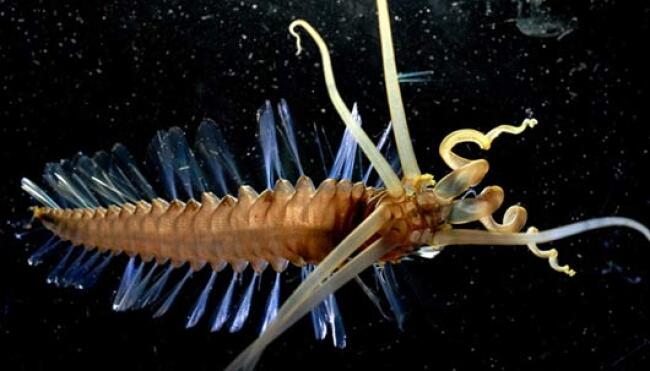
One discovery that attracted the attention of scientists was a sea worm that had a very unusual appearance. This animal is known as a squidworm, or scientifically called Teuthidodrilus saame. At first glance, its appearance resembles a combination of a squid and a worm, so researchers have given it the nickname “squidworm” or “squid worm”.
This unique creature was found in the Sulawesi Sea (Celebes Sea), namely the sea area between Indonesia and the Philippines. This discovery proves that the waters around Indonesia still contain extraordinary biological riches and are not yet fully known by the world of science.
Quote:
Discoveries that shocked the world of biology
Squidworms were first discovered in 2007 during a scientific expedition exploring the western Sulawesi Sea. The researchers used an ROV (Remotely Operated Vehicle), namely an underwater robot capable of diving thousands of meters below the sea surface.
This creature was found at a depth of around 2000 to almost 3000 meters. At this depth, no sunlight can penetrate the water so the environment becomes completely dark. The water temperature is also very low, while the water pressure reaches hundreds of times the air pressure at the earth’s surface.
The findings were then published in a journal Biology Lettersin 2010 by Karen J. Osborn and her colleagues. The publication introduced new genera and species that were previously completely unknown to science.
Quote:
Why is it Called Squidworm?
The name “squidworm” comes from its unique appearance. From the front of its body extended ten long tentacles that resembled squid arms. However, this animal is not actually a squid, but belongs to the group of hairy worms or polychaetaa member of the phylum Annelida which is in the same family as leeches and earthworms.
The squidworm’s body is about 9 centimeters long and about 1 centimeter wide. Its size is not very large, but the tentacles on its head can even be longer than its body.
Apart from the ten tentacles, the squidworm’s body also has a paddle-like structure on the side of the body. These structures help these animals swim actively in the water column. This is quite interesting because most of its close relatives actually live on the seabed, not swimming freely.
Quote:
Not a Seabed Dweller
What makes squidworms even more interesting is their lifestyle. Most marine worms live crawling on the sea floor or burrowing through sediment. On the other hand, squidworms actually live floating freely in the water column of the deep sea. Scientists call this type of habitat the deep sea pelagic zone.
This swimming ability allows squidworms to move around to find food without having to depend on the seabed.
Phylogenetic analysis shows that squidworms come from a group of worms that mostly live on the sea floor. Therefore, its swimming ability is considered to be a very interesting example of evolutionary adaptation.
Quote:
What Does It Eat?
The deep sea is not a place rich in food. No plants can carry out photosynthesis because sunlight never reaches that area.
As a result, most deep sea organisms depend on organic material that falls slowly from the ocean surface. This material is known as marine snowor “marine snow”. Its contents consist of fragments of dead plankton, remains of marine animal carcasses, mucus left by marine animals, and various other organic particles.
Squidworms use their long tentacles to catch these particles. The tentacles then direct the food towards the mouth so that the animal can obtain energy without needing to be an active predator. This strategy is very suitable for deep sea conditions that are poor in food sources.
Quote:
Adaptation to the Deep Sea
The squidworm’s living environment is one of the most extreme habitats on earth. Some of the challenges that must be faced include very high water pressure, temperatures approaching freezing point, no sunlight, and very limited food.
To survive, squidworms have various adaptations. Its body is relatively soft so it is able to adapt to high pressure. His organs have also evolved to continue functioning in extreme environments. Their swimming movements are quite efficient so that energy is not wasted when looking for food. These adaptations show how evolution is able to produce life forms that are very different from the organisms that live on the surface of the earth.
Quote:
Why is the Sulawesi Sea so Special?
The Sulawesi Sea is one of the deepest seas in the Southeast Asia region. Some parts of the basin are more than 6,000 meters deep. Apart from that, this sea is part of the Coral Triangle, which is the area with the highest level of marine biodiversity in the world.
Although famous for its coral reefs, deep sea areas also harbor very unique communities of organisms.
According to researchers, the Sulawesi Sea basin is relatively isolated from the surrounding ocean. These conditions allow the formation of species that are different from other marine areas. For this reason, the opportunity to find new organisms in this area is still very large.
Quote:
Why is this discovery important?
To the general public, squidworms may just look like strange animals with lots of tentacles. However, for scientists, this discovery has a much greater meaning.
First, the discovery shows that there are still many large species that have never been documented despite living in the oceans for millions of years. Second, squidworms help scientists understand how evolution can transform groups of seafloor animals into free-living organisms in the water column. Third, research on deep sea animals also has the potential to produce new knowledge regarding physiology, genetics, and adaptation to extreme pressure. This knowledge could one day be utilized in various fields, including biotechnology and materials science.
Quote:
Challenges of Deep Sea Research
Researching squidworms is not an easy task. The depth of thousands of meters makes routine human diving almost impossible. Therefore, scientists rely more on unmanned underwater vehicles equipped with high-resolution cameras, lights, sensors and robotic arms.
The cost of deep sea expeditions is also very expensive. One research trip can cost a huge amount of money because it involves research vessels, multidisciplinary teams, and high-tech equipment. As a result, the world’s deep sea areas remain far less studied than land.
Quote:
There are still many mysteries waiting
Squidworms are just one example of thousands of deep-sea organisms that have only become known in the last few decades. Whenever a scientific expedition explores a region that has never before been observed, there is almost always a chance of discovering a new species. In fact, experts estimate that most deep sea species still have not been scientifically named. This shows that the ocean is not only a source of food and a transportation route, but also a natural laboratory that stores important information about the evolutionary history of life on earth.
Indonesia, as the largest archipelagic country in the world, has a very important role in this research. The Sulawesi Sea is just one example that the waters of the archipelago still hold extraordinary biological riches that have not yet been fully discovered.
As underwater exploration technology continues to develop, it is not impossible that more organisms will be found whose appearance is even stranger than squidworms. Each new discovery will increase human understanding of life in an environment that has so far been almost untouched. The deep sea still holds many secrets, and squidworms are a reminder that nature is always capable of presenting surprises beyond human imagination.
Quote:
SOURCE
Nature. (2010). Zoology: Showcasing the sea’s strange secrets. Nature, 468(7323)602.
Osborn, K. J., Madin, L. P., & Rouse, G. W. (2011). The remarkable squidworm is an example of discoveries that await in deep-pelagic habitats. Biology Letters, 7(3)449-453.
National Center for Biotechnology Information. (2011). PubMed record: The remarkable squidworm is an example of discoveries that await in deep-pelagic habitats.
@vale79791@strangerfdotnet @jokingwet