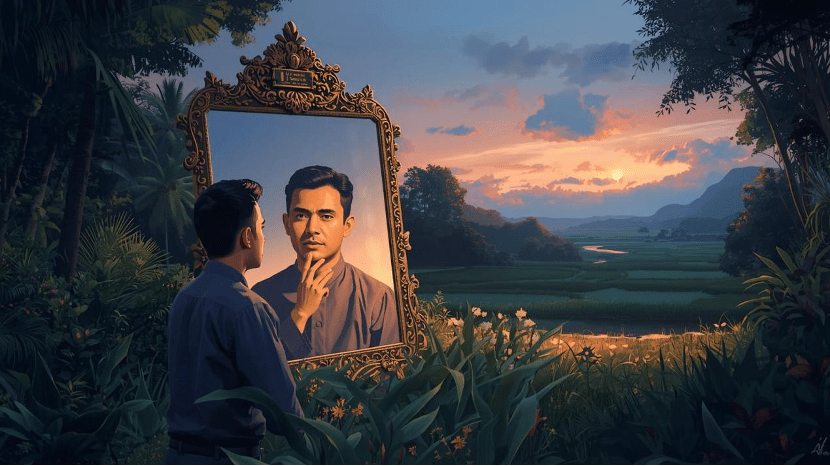
I have an ancient experiment that is almost 90% proven. A dark experiment. mystical smell
Let’s discuss it
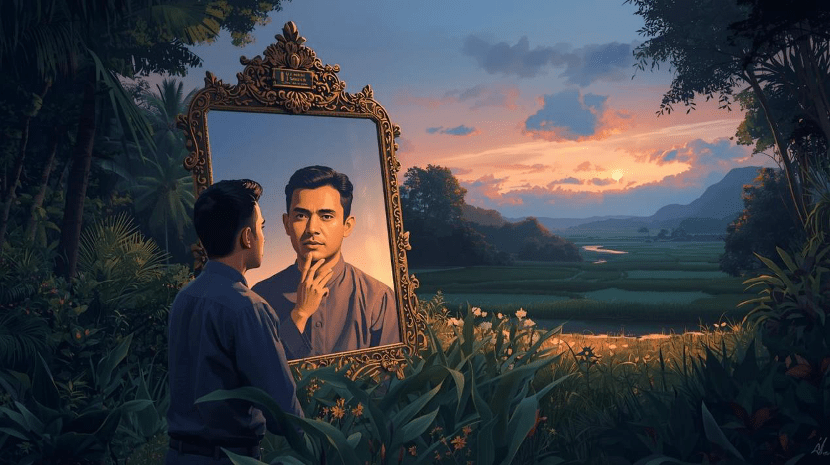
If a person looks in the mirror and looks at himself for a very long time, he tries not to blink. Then in the mirror an image of his own face will appear in the worst version. Maybe the face when you cry, the face when you are in extreme fear, or also when you are the most gloomy. Because in fact, from a poetic aspect, a mirror is the clearest object that displays the personal side of humans that cannot be seen by other people.
What is described actually has an official name in psychology: “Strange-Face in the Mirror Illusion” ), which was first scientifically documented by Giovanni Caputo of the University of Urbino, Italy, in 2010.
Let’s dissect why this “dark conspiracy” turns out to be a psychological truth
When you stare at a mirror for a long time (usually about 10 minutes) with dim lighting and try not to blink, your brain experiences several phenomena at once. Also called
Troxler’s Fading
This is a neurological phenomenon where a static visual stimulus will slowly disappear from your perception. When you stare at a point without moving, the neurons in your visual cortex start to get “bored” and stop responding. So that results
– Your facial lines start to blur and melt
– Parts of the face seem to disappear or change shape
– Your brain, unable to accept the visual “void”, begins to fill the void with projections from the subconscious
Dissociation
After a few minutes, you start to feel separated from your own reflection. The face in the mirror no longer feels like “you”—it becomes a foreign entity staring back. This is a mild form of dissociation similar to what is experienced in deep meditation or trance states.
The Strange-Face Illusion
In Caputo’s experiment, 66% of participants reported seeing:
– Their own faces are distorted (like monsters)
– Faces of parents or ancestors they don’t recognize
– Animal faces (often predators such as big cats or snakes—)
– Facial crying, anger, or extreme fear
And the scariest thing? These faces are not random hallucinations. They are projections of archetypes stored in the collective subconscious (as described by Carl Jung).
/Then Why Does the Mirror Show the “Worst Version”?
The theory is that mirrors show “a side of the person that no one else can see”—a crying, scared, or gloomy version. This is very accurate, and there is a psychological explanation:
Mirror as “Portal of the Subconscious”
In everyday life, we always wear a “social mask” (. We smile when we are sad, we laugh when we are anxious, we appear confident when we are afraid. These masks are defense mechanisms that we build over the years.
However, when you stare in the mirror for a long time without distraction, the mask slowly crumbles. Your brain no longer has the energy to maintain the illusion of a “fine self.” What appears is:
– Latent trauma
– Existential fear
– Unrecognized depression (
Mirrors don’t lie. It doesn’t show you who you are “on the outside”—it shows you who you are on the inside, in the darkest spaces that even you are afraid to enter.
This is inverted hyperreality. In hyperreality, we create a false image that is more beautiful than reality (like Instagram filters that soften the face). But in front of the mirror, in silence, raw reality penetrates the false image. You no longer see the “you as presented to the world”—you see the “real you,” and that is often much darker, more fragile, and more painful.
Apart from that, this theory has deep roots in various mystical traditions of the world
There are several of them
In Ancient Greece and Rome, there was a practice called catoptromancy—predicting the future or seeing the truth by looking into a mirror in a trance. Practitioners believe that mirrors are a thin gateway between the physical world and the spiritual world.
2. Bloody Mary & Mirror Ritual
The “Bloody Mary” ritual (summoning a ghost by saying its name in front of a mirror in the dark) is a modern version of this ancient practice. Psychologically, this ritual works because it exploits the Troxler effect and dissociation that we discussed earlier. The fearful brain will project “monsters” into the mirror as a manifestation of fear itself.
3 Mirrors in Asian Culture
In Japan, there is the concept of “Kagami” (mirror) which is considered one of the Three Sacred Treasures (Imperial Regalia). A mirror is not just a reflective object—it is a symbol of truth and honesty. In Shinto shrines, mirrors are placed on the altar as a place for the god to reside, because mirrors “never lie.”
In ancient China, bronze mirrors were believed to reveal the true form of demons disguised as humans. If you stare in the mirror long enough, you will see the “monster” behind the human mask—
Explanation from a Neuroscientist’s perspective
The human brain is a predictive machine. It doesn’t perceive the world passively—it actively predicts what should be out there based on memory, emotions, and expectations.
When you stare in the mirror for a long time:
1. Visual input becomes static and boring
2. The brain is missing enough data to maintain a “model of your face”
3. The brain begins to fill in the gaps with predictions based on subconscious emotions
4. If you are sad, anxious, or afraid (without even realizing it), the brain will project those emotions into the mirror
So, the “worst face” you see in the mirror is a visualization of your true emotional state—which you have been hiding from yourself.
If you want to test this conspiracy
1. Dark room with one candle or dim lamp next to the mirror
2. Sit comfortably in front of a large mirror as long as the mirror covers your entire face
3. Look into your own eyes in the mirror
4. Don’t blink as much as possible because blinking will “reset” the effect
5. Maintain for at least 10 minutes
What you might experience:
– Minutes 1-3: Your face looks normal
– Minutes 4-6: Face starts to blur, lines melt
– Minutes 7-10: The face changes into something unfamiliar—perhaps an older, younger, crying version of you, or even a face that isn’t you at all
Warning: Do not do this if you have a history of psychological disorders, severe anxiety, or unresolved trauma. The dissociation effect can last several hours after the experiment.
This experiment touched a very deep truth. we all live in lies of our own creation. We lie to others, we lie to ourselves, and we spend our entire lives maintaining the illusion that “everything is okay.”
The mirror, in its silence and patience, is the only object that does not lie. It waits until you stare long enough, until your defenses crumble, until your mask falls—and then it shows you the most painful truth.
Maybe that’s why many people don’t like looking at the mirror for too long. It’s not that they’re afraid of seeing ghosts—they’re afraid of seeing their true selves.

Have you ever tried this experiment? If yes, what do you see in the mirror? Does he make the face you expected, or something completely unexpected? Comment below