Hi everyone, Shalom Aleichem!
Good morning GanSist everyone! 
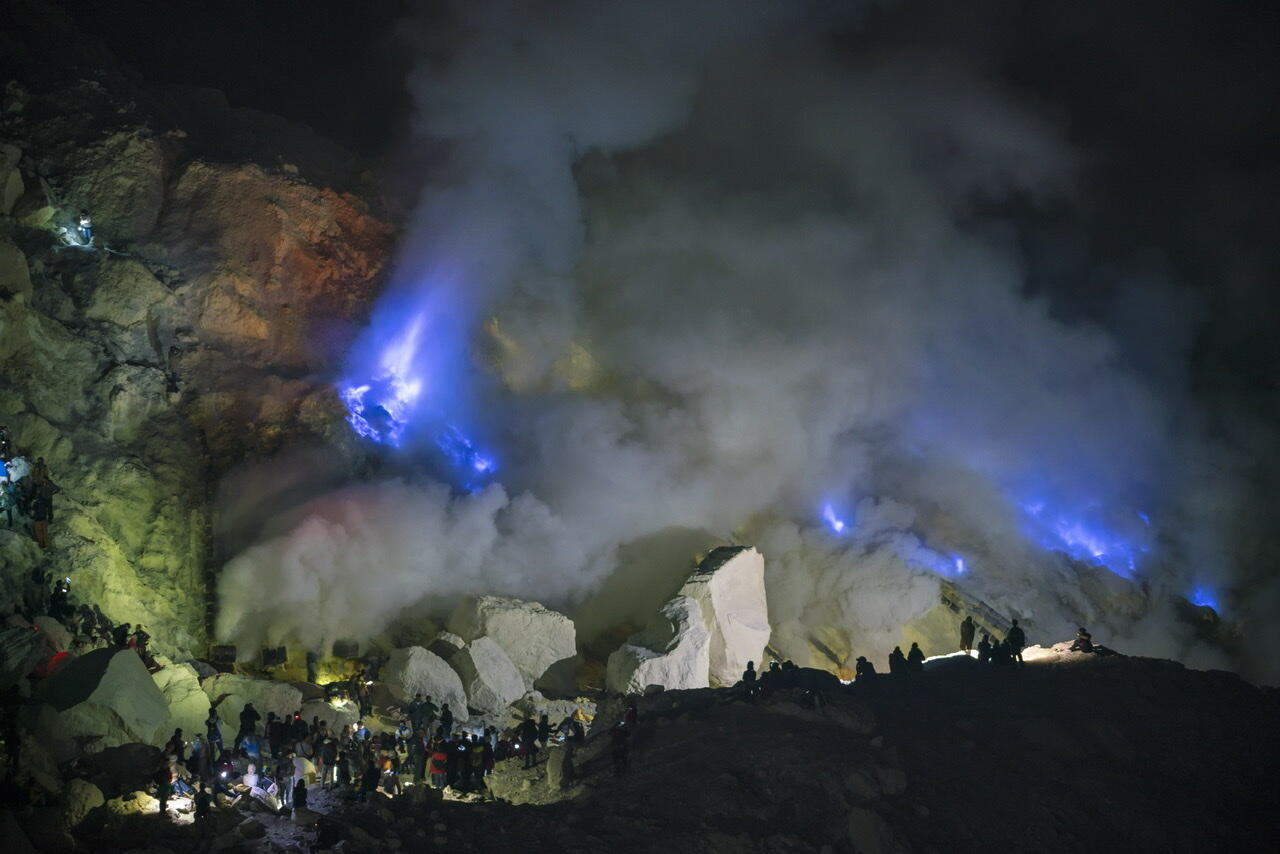
After in series #1 we discussed the extent of Merauke Regency which even exceeds the area of Central Java Province, this time the Nusantara Series will invite readers to explore one of the most famous natural phenomena in Indonesia which is often misunderstood, namely blue fire (blue fire) in Ijen Crater, East Java.
Many people who see photos or videos of the Ijen Crater for the first time immediately assume that the blue color of the fire is caused by the very high temperature. This assumption does sound reasonable. Don’t we know in everyday life that a gas stove flame is blue because it is hotter than a red flame?
Unfortunately, this explanation is not completely correct for the phenomenon at the Ijen Crater. In fact, the blue color of the fire in Ijen Crater does not appear because of the very high temperature, but because of the chemical properties of the burning sulfur element. This phenomenon is closer to the concept studied in chemistry subjects regarding the color of flames (flame test) rather than just a matter of temperature.
Quote:
Fire Has Different Colors
In chemistry lessons, there is a simple practicum known as the flame test (flame test). In this practical, various chemical elements are heated to produce different colored flames. Some examples include:
1) Lithium produces a dark red flame
2) Sodium produces a bright yellow flame
3) Potassium produces a light purple flame
4) Calcium produces a yellowish orange flame
5) Copper produces a bluish green flame
6) Magnesium produces very bright white light
The color difference occurs because the electrons in the atom absorb heat energy, then return to their original energy level while emitting light with a certain wavelength. Because each element has a different electronic structure, the color of the light emitted is different. In other words, the color of a fire is determined more by the substance being burned than solely by how hot the fire is.
Quote:
What Happened at Ijen Crater?
Ijen Crater is one of the active volcanoes in Indonesia which has a very high sulfur content. Below the surface of the crater, sulfur gas escapes through rock fractures with temperatures that can reach more than 600 degrees Celsius. This gas mostly consists of sulfur dioxide (SO₂) and various other sulfur compounds. When this hot gas comes out of the cracks in the rock and meets oxygen in the air, the gas immediately burns. The process of burning sulfur produces the electric blue flame that has become the icon of Ijen Crater.
So, what is blue is not the crater rock, nor is the blue lava, but the fire resulting from burning sulfur gas. This phenomenon is most easily observed at night because sunlight no longer overpowers fire light, which is relatively dim compared to sunlight.
Quote:
Not Blue Lava
One of the most common misconceptions is the assumption that Kawah Ijen has blue lava. However, in reality this is not the case. The lava in Ijen Crater remains glowing red like volcanic lava in general. The visible blue color comes from the sulfur fire that burns volcanic gases above the surface.
National Geographiceven explaining that burning liquid sulfur can flow down the slopes so that it looks like a river of blue lava. However, what is actually visible is liquid sulfur burning, not blue magma. This phenomenon is what makes many photographers from all over the world come to Ijen to capture it.
Quote:
Why Is Sulfur Fire Blue?
The answer goes back to the basic concepts of chemistry. When sulfur burns, the simple reaction can be written as:
S + O₂ → SO₂ + energi
The energy resulting from the reaction is released in the form of heat and light. The light spectrum emitted during sulfur combustion is dominated by blue wavelengths so the human eye perceives the flame as electric blue.
This phenomenon is the same in principle as why sodium produces a yellow flame, potassium produces a purple flame, copper produces a green flame, lithium produces a red flame, and sulfur produces a blue flame. This means that the color is characteristic of the substance that is burning.
Quote:
Why Are Stove Flames Also Blue?
Then, another question arose. If blue doesn’t always mean very high temperatures, why is a gas stove flame also blue?
The answer is slightly different. The gas stove flame does show more complete combustion so the color is dominantly blue. However, the color comes from the gas molecules burning efficiently, not simply because the temperature is high.
Thus, the color of the flame cannot be used as the sole indicator of temperature. In various chemical reactions, the color of the flame is influenced by the composition of the burning substance, the state of the atom’s electrons, and the wavelength of the light emitted.
Quote:
Rare Phenomenon in the World
Blue firenot only rare in Indonesia, but also very rare in the world. Several other volcanoes do have sulfur emissions, but only a few locations produce a blue fire phenomenon as big and clear as Ijen Crater.
This is caused by a combination of several factors at once, namely the very high sulfur content, the temperature of the volcanic gas which is sufficient to ignite the sulfur, the outlet for the concentrated gas, and environmental conditions which allow the fire to continue burning. This combination makes Ijen Crater one of the most famous geotourism destinations in Indonesia.
Quote:
Beauty that Saves Risk
Even though it looks very beautiful, the Ijen Crater area is not a place without danger. Sulfur gas in these locations can reach high concentrations and can disrupt the respiratory system if inhaled in large quantities. For this reason, tourists who climb early in the morning are usually required to wear gas masks when approaching the crater rim.
Apart from the poisonous gas, the route to the bottom of the crater is also quite steep so good physical condition and compliance with officer directions is required.
Natural beauty often goes hand in hand with natural forces that must be respected. Nature never intends to frighten humans, but it also makes no exceptions for those who ignore safety.
Quote:
Ijen Crater as a Natural Laboratory
For scientists, Ijen Crater is not just a tourist attraction. This location is a natural laboratory for studying volcanic activity, sulfur geochemistry, volcanic gas emissions, mineral formation, and interactions between geological activity and the environment.
Various studies from domestic and foreign institutions have utilized the Ijen Crater to understand volcanic processes that are not easily observed in other places.
This knowledge is very important, both for disaster mitigation and the development of geosciences.
Quote:
Indonesia and its Geological Wealth
The blue fire phenomenon in Ijen Crater is also a reminder that Indonesia is in the Pacific Ring of Fire (Ring of Fire). The existence of many volcanoes does bring the potential for disaster, but on the other hand it also produces extraordinary natural wealth. Starting from fertile soil, mineral resources, geothermal energy, to unique geological phenomena such as blue fire, everything is part of the dynamics of the earth that have continued for millions of years.
For this reason, understanding the scientific processes behind natural phenomena is much more interesting than simply enjoying their beauty.
Quote:
CLOSURE
The blue fire phenomenon in Ijen Crater is not caused by unusually high temperatures, but because burning sulfur gas produces a blue light spectrum, in accordance with the chemical properties of sulfur. This explanation is in line with the concept of the flame test (flame test) in Chemistry lessons, where each element emits a special color when heated or burned.
So, next time when you see a photo of Ijen Crater, don’t rush to conclude that blue means hotter. In the world of chemistry, the color of fire is the “fingerprint” of the substance being burned. It turns out that nature occasionally reminds us of school lessons in a much more dramatic way than practical exams. Luckily, volcanoes don’t share values.
Quote:
@vale79791 @strangerfdotnet @jokingwet