Hi everyone, Shalom Aleichem!
Good evening GanSist everyone! 
Have we ever wondered why a dove can return to its cage even though it has been released tens to hundreds of kilometers away? This ability has long attracted the curiosity of scientists. Pigeons do not carry compasses, do not use GPS, and do not read maps. However, they are able to determine direction with an extraordinary degree of precision.
Over the years, researchers have discovered that birds’ navigational abilities depend not only on the position of the Sun, star patterns, or memory of the landscape. One of the most important components is the ability to detect the Earth’s magnetic field, an ability known as magnetoreception (magnetoreception).
What’s even more interesting is that this mechanism apparently involves physics concepts that are usually only studied in college, one of which is the Zeeman Effect. This phenomenon, discovered more than a century ago, is now one of the keys to understanding how birds can “feel” north and south without any tools.
So, what is the relationship between the Zeeman Effect and the navigational abilities of pigeons? Let’s discuss them one by one.
Quote:
What is the Zeeman Effect?
The Zeeman effect is a physical phenomenon when the spectrum of an atom or molecule which originally had one spectrum line changes to several lines after being subjected to a magnetic field.
This phenomenon was first discovered by Dutch physicists Pieter Zeemanin 1896. This discovery later became important evidence that magnetic fields can influence the energy levels of electrons in atoms.
In simple terms, electrons have a property called spin. This spin causes the electrons to act like very small magnets. When in a magnetic field, the spin orientation of electrons can change so that their energy levels shift slightly.
This change in energy is known as Zeeman splitting (Zeeman splitting). Although the energy changes are very small, in the world of quantum physics they are large enough to change the outcome of certain chemical reactions.
This is where the story gets even more interesting.
Quote:
The Earth’s Magnetic Field Turns Out to be Very Weak
Many people think that the Earth’s magnetic field is very strong. However, in reality this is not the case. The strength of the Earth’s magnetic field is only around 25–65 microtesla, much smaller than the magnets on cellphone speakers or the magnets on refrigerators that we use every day.
Logically, such a weak magnetic field should not be able to have a significant influence on chemical reactions in the bodies of living things.
However, this is precisely where its uniqueness lies. Over the past few decades, various studies have shown that there are certain chemical reactions that are very sensitive to even the slightest changes in the magnetic field. The reaction involves pairs of electrons known as radical pairor radical pairs.
This mechanism is currently the main theory in explaining magnetoreception in birds.
Quote:
Theory Radical Pair
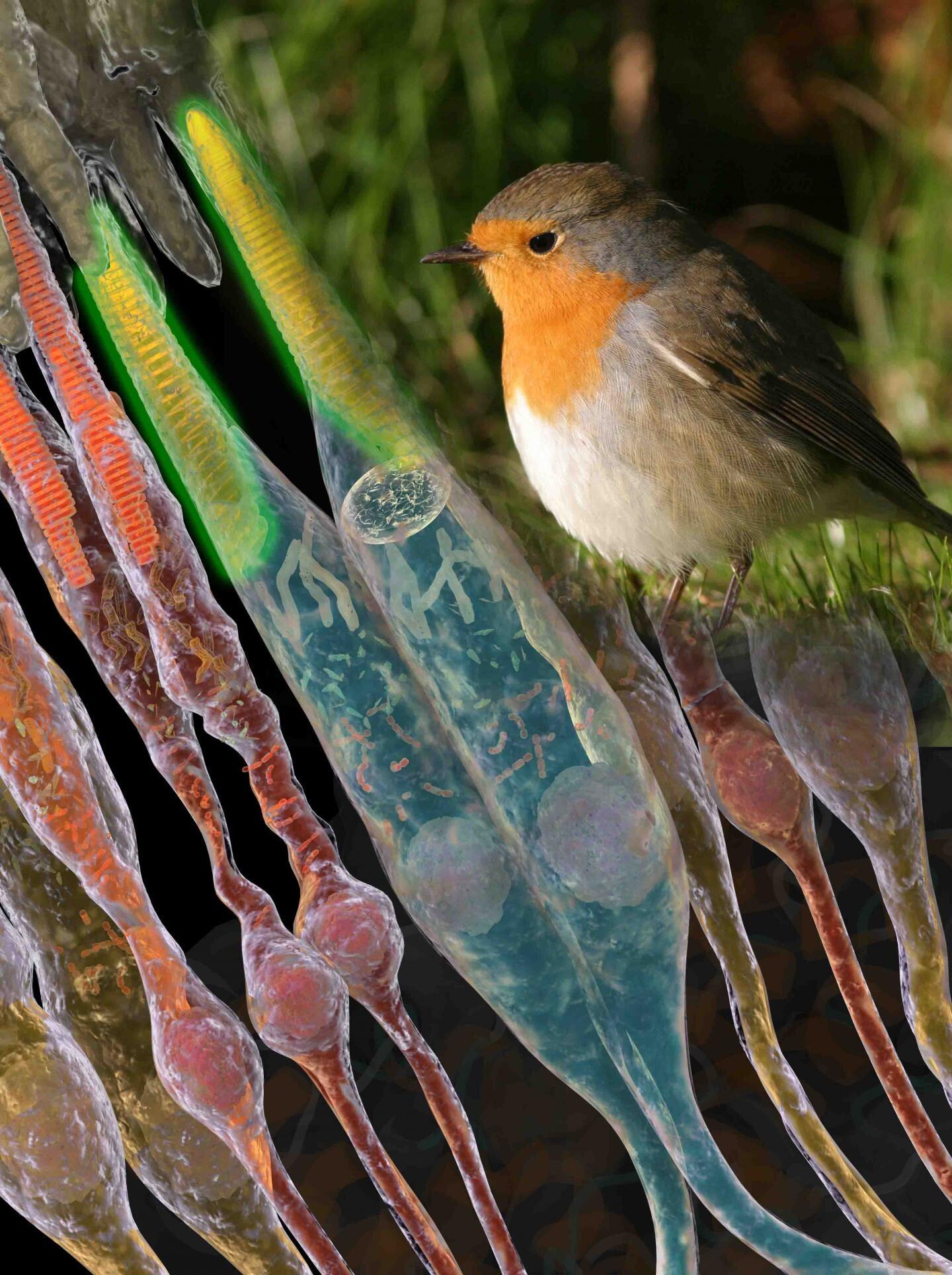
According to theory radical paircertain molecules in the retina of a bird’s eye will absorb light. Absorption of this light produces two radical molecules, each of which has one unpaired electron.
These two electrons have a very unique quantum relationship. Both can be in a singlet or triplet state, which determines the course of the next chemical reaction.
Very small changes due to the interaction of electrons with a magnetic field through Zeeman interactions can change the chances of forming certain reaction products.
This means that the Earth’s magnetic field does not work by “pulling” or “moving” birds directly.
In contrast, magnetic fields influence electron spin dynamics during chemical reactions.
The changes in the reaction results are then translated by the nervous system into information about the direction of the magnetic field.
In other words, birds don’t actually have a mechanical compass in their bodies, but instead have a biochemical system that is very sensitive to magnetic fields.
This phenomenon is a great example of how quantum physics can play a role in biological processes.
Quote:
The Role of the Zeeman Effect in This Mechanism
So, where does the Zeeman Effect stand? The Zeeman effect arises because the electron spin in a radical pair experiences a change in energy when in the Earth’s magnetic field. This energy change is very small, but enough to affect the change between singlet and triplet states. It is these changes that ultimately determine the final outcome of the chemical reaction.
In other words, without the Zeeman interaction, the radical pair would not be sensitive enough to the direction of the magnetic field.
So, the Zeeman Effect can be considered as one of the basic physics that allows the magnetoreception mechanism to work.
Although birds certainly cannot consciously “calculate” the energy of electrons, the laws of physics still operate at the molecular level.
Quote:
Protein CryptochromeSuspected to be the Key
Modern research suggests that the protein most likely to play a role is cryptochrome. This protein is found in the retina of the eyes of various types of birds, including birds that have excellent navigation abilities.
Cryptochrome is a photoreceptor, which is a protein that is active when exposed to blue light. When absorbing light, the protein produces radical pairs which then experience spin dynamics.
If the magnetic field changes orientation, the spin dynamics also change through Zeeman interactions. As a result, the resulting chemical reaction products are slightly different. These differences are believed to be translated by the nervous system into information about direction.
For this reason, many researchers suspect that birds actually “see” magnetic field patterns that overlap with their vision of the real world.
Quote:
What About Pigeons?
Pigeons (homing pigeon) is one of the animals most frequently studied in navigation research.
Various experiments show that when the magnetic field around a bird is manipulated, its navigation abilities can be disrupted.
However, the researchers also discovered that pigeons do not rely on just one navigation system. They utilize various sources of information simultaneously, including the Earth’s magnetic field, the position of the Sun, polarized light patterns, smells from the surrounding environment, visual markers in the form of landscapes, and previous travel experiences.
Therefore, if one cue is disrupted, the bird can still use the other cue. This explains why birds’ navigational abilities remain excellent despite changing environmental conditions.
Quote:
Still a Mystery
Although theoretical radical pairis the strongest explanation to date, there are still many unanswered questions. For example, how exactly are these chemical signals translated into perception of direction? How does the bird’s brain process that information? Why do only certain species have very high magnetic sensitivity? The answers to these questions are still being researched.
Scientists from the fields of physics, chemistry, biology and neuroscience are working together to understand this very complex mechanism.
Interestingly, research on magnetoreception is not only useful for understanding bird behavior.
The knowledge could also help the development of much more sensitive magnetic sensors, even inspiring new navigation technologies that work on quantum principles.
Quote:
CLOSURE
The Zeeman effect may sound like a physics concept that is only relevant in the laboratory. However, nature shows that this phenomenon can be exploited by living creatures through very complicated mechanisms.
In pigeons, the Earth’s very weak magnetic field is thought to be able to influence the spin of electrons in radical pairs in proteins cryptochrome. Through Zeeman interactions, small changes in electron energy levels can change the course of chemical reactions, which the nervous system then interprets as directional information.
Although these mechanisms are still being researched, the available scientific evidence increasingly strengthens the idea that bird navigation is a fascinating combination of biology, chemistry, quantum physics, and evolution.
This phenomenon is a reminder that nature often exploits seemingly complex physical principles to produce extraordinary biological capabilities. Pigeons are not just animals that are good at finding their way home, but are also one of the most interesting examples of how the basic laws of nature work in harmony in life.
Quote:
SOURCE
Fay, T. P., Lindoy, L. P., Manolopoulos, D. E., & Hore, P. J. (2020). How quantum is radical pair magnetoreception? Faraday Discussions, 22177–91.
Hore, P. J., & Mouritsen, H. (2016). The radical-pair mechanism of magnetoreception. Annual Review of Biophysics, 45299–344.
Ritz, T., Adem, S., & Schulten, K. (2000). A model for photoreceptor-based magnetoreception in birds. Biophysical Journal, 78(2)707–718.
Rodgers, C. T., & Hore, P. J. (2009). Chemical magnetoreception in birds: The radical pair mechanism. Proceedings of the National Academy of Sciences, 106(2)353–360.
Stoneham, A. M., Gauger, E. M., Porfyrakis, K., Benjamin, S. C., & Lovett, B. W. (2012). A New Type of Radical-Pair-Based Model for Magnetoreception. Biophysical Journal, 102(5)961–968.