Hi everyone, Shalom Aleichem!
Good afternoon GanSist everyone! 
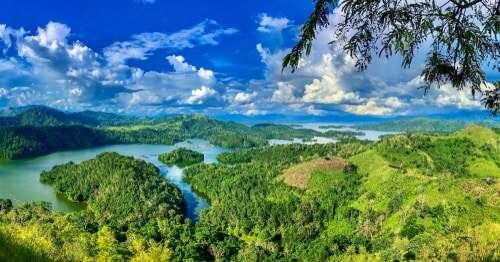
Welcome back to the Nusantara Series, a series that invites us to explore Indonesia’s riches from various points of view, starting from culture, local wisdom, tourist attractions, history, to the natural wonders that this country has. In the previous series, we visited Lake Labuan Cermin in East Kalimantan which is famous because it has two layers of water with different characters. This time, our journey continues on Kalimantan Island, but towards an area that is much wilder, quieter and still very natural, namely Kayan Mentarang National Park in North Kalimantan Province.
The name of this national park may not be as popular as Komodo National Park or Bromo Tengger Semeru National Park. However, make no mistake. Among conservation scientists, Kayan Mentarang is one of the most important tropical rainforest areas in Southeast Asia. This area is not only home to thousands of types of wild plants and animals, but is also home to the Dayak indigenous people who have lived side by side with nature for centuries.
The uniqueness of Kayan Mentarang National Park lies not only in its area, but also in its ecological, cultural and scientific values. It is no exaggeration that this area is often referred to as one of the last bastions of tropical rainforest on the island of Kalimantan.
So, what are the unique facts that make this national park so special?
Quote:
1. It is one of the largest intact tropical rainforest areas in Southeast Asia
The first fact that makes Kayan Mentarang very important is the area and condition of the forest.
Kayan Mentarang National Park has an area of around 1.27 million hectares, making it one of the largest national parks in Indonesia. This area is dominated by primary forest and old secondary forest which are still well maintained. In contrast to many other forest areas that have experienced fragmentation due to development, most of the Kayan Mentarang area still maintains its natural condition.
The natural landscape is very diverse, ranging from lowland rainforests, mountain forests, to moss forests in higher areas. This diversity of ecosystems allows various types of plants and animals to develop in suitable habitats.
The existence of large forests also plays an important role in absorbing carbon, maintaining the water cycle, and helping reduce the impact of climate change. In other words, the benefits of Kayan Mentarang are not only felt by the surrounding community, but also by the environment on a much wider scale.
Quote:
2. Home to Thousands of Flora and Fauna Species
The vast area is certainly a habitat for extraordinary biodiversity.
According to data from the Kayan Mentarang National Park Center and the Ministry of Forestry, this area is inhabited by around 100 species of mammals, including 15 endemic mammal species, 8 primate species and more than 310 bird species, with dozens of them endemic to Kalimantan. Apart from that, there are still various types of reptiles, amphibians, insects and plants which continue to be researched today.
Important animals such as Kalimantan orangutans, clouded leopards, sun bears, antelopes, hornbills and various types of birds of prey can still be found in this area.
Meanwhile, in terms of flora, Kayan Mentarang is a habitat for various trees typical of tropical rain forests such as jelutung, agathis, ramin and various types of wild orchids.
This biodiversity shows that this area still has excellent habitat quality so that it is able to support the life of various species that are sensitive to environmental disturbances.
Quote:
3. Dayak Indigenous Peoples Live Side by Side with Conservation Areas
One of the things that makes Kayan Mentarang different from many other national parks is the presence of indigenous people who have lived around the area for a long time.
Several Dayak community groups, such as Dayak Kenyah, Dayak Lundayeh, Dayak Kayan, and Dayak Punan, have inhabited this area long before the area was designated as a national park.
Interestingly, when the area’s status was changed to a national park in 1996, the government specifically took into account the presence of indigenous communities and recognized the importance of traditional use of natural resources in certain zones. This approach is one of the first examples of conservation area management that pays attention to the rights and lives of local communities in Indonesia.
Over the years, indigenous peoples have developed various customary rules regarding forest use, hunting, and natural resource management. These values help maintain a balance between human needs and environmental sustainability.
This shows that conservation does not always mean separating humans from nature. In many cases, indigenous communities are an important part of efforts to preserve forests.
Quote:
4. Directly borders Malaysia and is a cross-border conservation area
This is the most astonishing fact.
Kayan Mentarang National Park is right on the border between Indonesia and the State of Sarawak, Malaysia. Because of its strategic location, this area together with Pulong Tau National Park in Malaysia forms a cross-border conservation area or Transfrontier Park.
The concept of transnational conservation is very important because wildlife does not recognize administrative boundaries. Orangutans, hornbills, clouded leopards and various other animals can move across borders according to their habitat needs.
Through cross-border cooperation, the two regions can support each other in protecting biodiversity, scientific research, monitoring wildlife, and controlling threats such as illegal logging and illegal wildlife trade.
The existence of this cross-border conservation area also shows that nature conservation requires cooperation that goes beyond national borders. Nature does not follow lines on a map, so efforts to protect it require extensive collaboration.
Quote:
CLOSURE
Kayan Mentarang National Park is proof that Indonesia still has tropical rainforest areas that are very valuable for the world. The intact forests, rich flora and fauna, the existence of indigenous peoples who live in harmony with nature, and its position as a cross-country conservation area make this national park have a meaning that goes far beyond its function as a tourist destination.
Through the Nusantara Series, we again realize that Indonesia’s wealth is not only in the form of historical buildings or beautiful panoramas. Conservation areas such as Kayan Mentarang are natural laboratories that store important information regarding evolution, ecology, climate change, and the harmonious relationship between humans and the environment.
The more people know about this area, the greater the hope that the remaining forests can continue to be protected. Because, protecting Kayan Mentarang means protecting one of the last bastions of Southeast Asia’s biodiversity while also passing on invaluable natural wealth to future generations.
Quote:
SOURCE
Kayan Mentarang National Park Hall. (2026). History of Kayan Mentarang National Park. Ministry of Forestry of the Republic of Indonesia.
Kayan Mentarang National Park Hall. (2026). Profile of Kayan Mentarang National Park. Ministry of Forestry of the Republic of Indonesia.
Directorate General of Natural Resources and Ecosystem Conservation. (2025). Information on 521 Conservation Areas: Kalimantan and Sulawesi Regions. Ministry of Forestry of the Republic of Indonesia.
Key Biodiversity Areas. (2001). Kayan Mentarang (Site 15918): Site factsheet. BirdLife International & KBA Partnership.
@which@strangerfdotnet @jokingwet