Hi everyone, Shalom Aleichem!
Good morning GanSist everyone! 
When most people hear the word winter, they immediately imagine snow falling in Japan, South Korea, Europe or North America. This is natural because winter is synonymous with countries in subtropical and temperate climates.
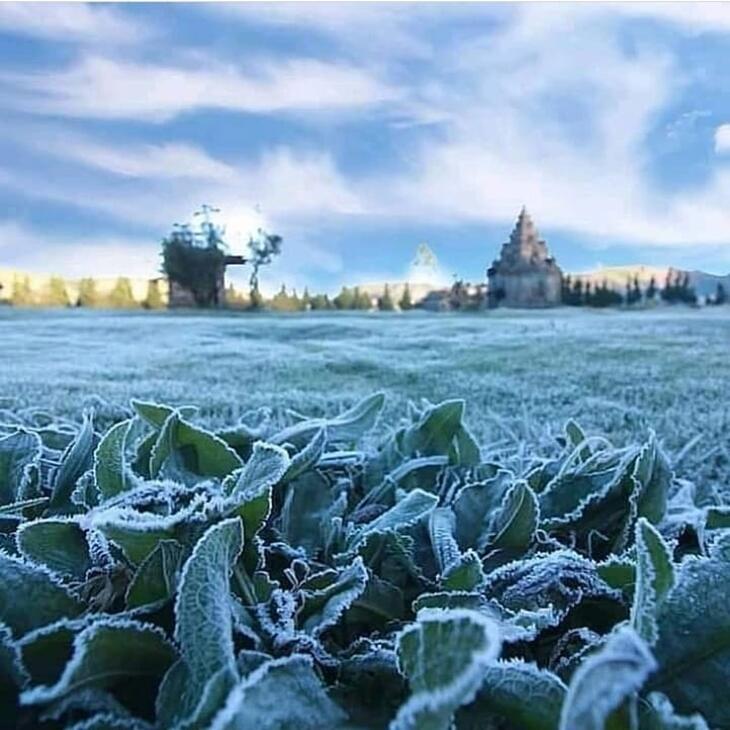
However, Indonesia apparently has a phenomenon that at first glance resembles winter. This phenomenon can be found in the Dieng Plateau, Central Java, especially when the dry season reaches its peak. The expanse of grass, leaves, and even the roofs of buildings can appear white as if they were covered in snow. By local people, this phenomenon is known as dew upas or bun upas.
Even though it is often nicknamed “Dieng snow”, this phenomenon is actually not snow like what happens in four-season countries. Upas dew is dew that freezes on the surface of objects due to air temperatures dropping to near or even below freezing point. This phenomenon commonly occurs in the dry season, especially around July to August, when the sky is clear and the night air loses heat very quickly.
So, what are the interesting facts behind the Dieng winter?
Quote:
1. This happens precisely during the dry season
This is the most surprising fact. Many people think that frost will appear during the rainy season because the air feels colder. In fact, what happened was the opposite. The dew phenomenon most often appears in the dry season.
According to BMKG, during the dry season the sky tends to be clear so there are almost no clouds which function as a “blanket” to retain geothermal heat. At night, the heat stored on the ground surface is released into the atmosphere through radiation so that the surface temperature drops drastically. If it reaches a certain point, the dew that forms will freeze into ice crystals.
In other words, the dry season actually provides ideal conditions for frost to form in Dieng.
Quote:
2. Not Snow, But Frost
Even though it is often called Dieng snow, this term is actually not scientifically correct.
Snow is formed from water vapor that freezes into ice crystals in clouds, then falls to the earth’s surface as precipitation.
Meanwhile, dew forms when water vapor directly condenses on the surface of leaves, grass, soil or other objects, then freezes because the surface temperature is very low. As a result, the entire surface appears sparkling white so that from a distance it looks like it is covered in snow.
This difference in the formation process is what differentiates dew from snow in four-season countries.
Quote:
3. Nicknamed “Poison Dew”
The name “upas” in the local language means poison. Of course, this dew is not poisonous to humans. This term arose because frost can damage agricultural crops, especially potatoes which are widely cultivated in Dieng. Leaves covered with a layer of ice experience tissue damage due to low temperatures so that the plants turn yellow, wilt, and even die if the frost is thick enough.
For tourists, dew upas is a beautiful sight. On the other hand, for farmers, this phenomenon often poses a threat to their harvests. Two different points of view on the same natural phenomenon.
Quote:
4. Dieng Has Supportive Geographical Conditions
The Dieng Plateau is at an altitude of around 2000 meters above sea level. The higher a place, the lower the air temperature is generally.
Apart from that, Dieng’s topography in the form of a mountainous basin means that cold air easily gathers at night until early morning.
Coupled with the east monsoon blowing from the Australian Continent which brings colder air masses during the dry season, the temperature in Dieng can drop to close to sometimes even below 0 degrees Celsius at ground level.
This combination of factors means that frost can form almost every year if weather conditions are favorable.
Quote:
5. Rare Phenomenon that is a Tourist Attraction
Ironically, a phenomenon that is detrimental to farmers has actually become a tourist magnet. Every time hard dew is expected to appear, many tourists come early in the morning to see the expanse of ice crystals in the Arjuna Temple Complex and its surroundings. The view of grass turning white in the morning sun creates a very different panorama compared to tropical views in general.
It is not surprising that upas dew becomes one of Dieng’s tourist icons every dry season.
Quote:
How to Enjoy Dieng Winter Safely
The beauty of dew will certainly be more effective when enjoyed with the right preparation.
First, come during the dry season, especially around July to August, because the chance of frost is greater.
Second, leave early in the morning. Frost usually begins to appear near sunrise and slowly melts as sunlight begins to warm the surface.
Third, wear layers of clothing. The air temperature in Dieng in the early hours of the morning can feel very cold for Indonesian people who are used to living in tropical areas.
Fourth, wear comfortable footwear because the grass or paths can become slippery due to dew.
Fifth, don’t step on areas filled with frost just to get a unique photo. Apart from damaging plants and vegetation, this action also reduces the opportunity for other visitors to enjoy the natural beauty of nature.
This phenomenon is much more beautiful when enjoyed with respect for nature than just being a selfie background.
Quote:
CLOSURE
Winter Dieng proves that Indonesia still has many natural phenomena that are no less interesting than other countries. Even though it is not snow in the meteorological sense, dew presents a unique sight and is proof that local geographic and climatic conditions can create extraordinary events in tropical regions.
Behind the alluring white expanse, there is a scientific explanation regarding heat radiation, air humidity and the formation of frost. On the other hand, there are also stories of farmers who have to face the risk of crop failure every time the dew comes. Nature often presents two faces at once. What is considered a miracle by tourists, can be a test for those who depend on the fields for their living.
Quote:
SOURCE
Meteorology, Climatology and Geophysics Agency. (2021). Pay attention to the period of occurrence of Upas and Bedding Dew. (url)https://www.bmkg.go.id/article/mencermati-period-terjadinya-embun-upas-dan-bediding(/url)
Harmoko, IW (2021). Paying close attention to the period when the Upas and Bedding Dew Phenomenon occurs. Semarang Class I Climatology Station, BMKG.
BETWEEN. (July 9, 2026). Banjarnegara Dinparbud: Dew upas has become a tourist magnet for Dieng. ANTARA News.
Kompas.com. (10 July 2026). Why is Dieng Covered with Ice During the Dry Season? This is the BMKG explanation. Compass.
@vale79791@strangerfdotnet @jokingwet